 Dogs & Cats
 Cattle
 Equine
 Poultry
 Swine
Swine Goats & Sheep
 Game Bird
 Gamecock
 Deer & Wildlife
 Fish & Pond
 Rabbit
 Specialty
 Ingredients & Bulk
 Special Order
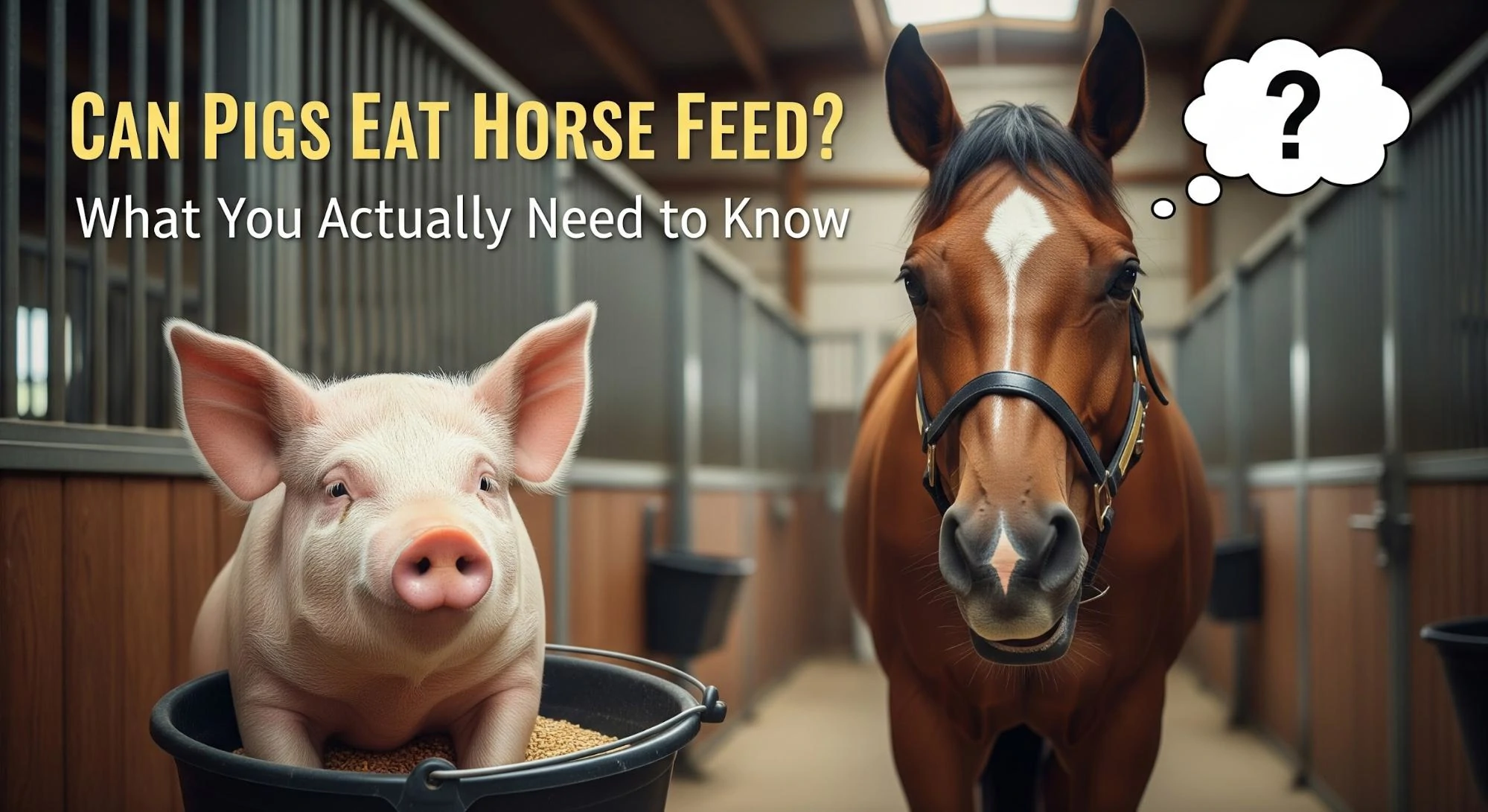
And, as a farmer who has to work with various kinds of livestock, you must have asked yourself: can pigs eat horse feed? It is a realistic question that arises in the real-life farm scenarios. You may have some extra horse feed or, you may need to find methods to stretch your feed budget. The simple answer is yes- pigs can feed on horse food and most farmers are feeding them on horse feed.
Why Farmers Ask This Question
The truth about farming is that you are ever in search of a workable solution. Livestock operations have feed costs that are 50-70 percent of the total production costs. By posing the question can pigs eat horse feed, farmers are posing a reasonable economic question. The question is pertinent in cases where you still have horse food left, you are efficient at feed storage, or you just need to trim overall feeding costs at your business.
It is more about what is happening on the ground rather than what theoretically should be happening in a textbook. There must be real solutions for real farmers.
The Direct Answer: Yes, Pigs Can Eat Horse Feed

What is important here is that pigs can eat horse feed? Pigs can eat horse feed, yes. They succeed in doing it in farms within the country. The apprehension that it is dangerous or toxic has no practical farm experience behind it. It is not a new development that the farmers have been adding horse feed to pig diets.
Pigs are adaptable omnivores that can thrive on various feed combinations. Horses and pigs both eat many of the same base ingredients: grains like oats, barley, and corn; legumes; and various seed meals. When your horse feed is primarily composed of these ingredients, there’s significant nutritional overlap that makes it suitable for pigs.
Is Horse Feed Safe for Pigs?
You should have a pragmatic response when posing a question like, is horse food safe to pigs. Yes–horse food is good pig food. No ingredients that are typical of a good horse food are toxic or harmful to swine. When fed on, horse feed does not include anything that will make your pigs sick.
A large proportion of farmers feed pigs on a mixture of or partial feeds that include horse feed without any difficulties. Overlapping feed supplies are usually successful in the well-managed farms where the horses and the pigs share the same feed. In case it were truly hazardous, we would find problems in the farms in large numbers and we just do not.
Is Horse Feed Toxic to Pigs?
The immediate one: is horse food poisonous to swine? No. Pigs are not sensitive to horse feed. This is a significant difference. It does not contain any toxicant that renders it inappropriate in terms of toxicity. Good horse food is produced using the components that constitute pig food, such as grains, vegetable proteins, vitamins, and minerals, which are regarded as the basic components. The percentages of the formulation vary but the ingredients are not problematic to the pigs.
What Can Pigs Eat? Understanding Dietary Flexibility
To see whether people can feed pigs on horse feed, it is good to know the bigger question: what can people feed pigs on? The pigs are very versatile feeders. They are foragers, omnivores, which naturally forage and eat a great variety of food. This is one of their most viable benefits since livestock animals are flexible.
Corn, barley, oats, wheat and rye are some of the grains that pigs can eat. They feed on legumes such as soybean, peas and alfalfa. Pumpkins, squash, and carrots are vegetables that can be fed on pigs. Numerous fruits such as apples are healthy. Quality pasture provides growing pigs with an added nutrition. And they too can eat horse feed.
That is why pigs are such useful livestock animals due to this dietary flexibility. The pigs have the ability to adjust to different feeds that can be found in your farm unlike other specialized animals. This is the reason why farmers have been able to raise pigs successfully over thousands of years- they can do what they have.
Practical Feeding Scenarios That Work
Let’s examine real situations where farmers successfully use horse feed for pigs:
Supplying growing pigs: Numerous pig farmers feed their pigs on horse food as a supplement, instead of wholly depending on commercial pig food. They also add a little horse food to lengthen the food bill and their pigs grow well.
Finishing pigs: At the finishing stage where pigs are almost full developed, there is no strong nutritional demand as at the rapid growth stage. Horse feed is effective in most of the operations.
Older breeding stock: Mature breeding pigs and sows which are not under intensive production are able to better manage the variance of feed compared to growing piglets. Horse feed is another product that is given by many farmers to breeding animals.
Emergency feed situations: When the pig feed runs out or the unexpected discontinuation of the supply occurs, it has been a saving factor to have horse feed on hand to save many farming operations severe problems.
Mixed feeding: When there are horses and pigs on the farm they may evolve mixed feeding where the feed sources suit both species.
Comparative Feed Ingredient Analysis
| Common Ingredient | In Horse Feed | In Pig Feed | Nutritional Value for Pigs |
| Corn | Yes | Yes | Excellent energy source |
| Oats | Yes | Sometimes | Good digestible grain |
| Barley | Yes | Yes | Excellent nutritious grain |
| Soybean Meal | Yes | Yes | Excellent quality protein |
| Alfalfa | Yes | Sometimes | Good fiber and nutrients |
| Molasses | Yes | Sometimes | Good energy and palatability |
| Salt | Yes | Yes | Essential for both |
| Vitamin Premix | Yes | Yes | Essential for both species |
This table shows why pigs eat horse feed makes practical sense—they share many of the same nutritional foundations with similar base ingredients.
Nutritional Comparison: What’s Different
| Aspect | Horse Feed | Pig Feed (Growing) | Implication |
| Protein Level | 8-12% | 14-16% | Horse feed lower but supplementing works |
| Fiber Content | 10-15% | 4-8% | Slightly higher but digestible for pigs |
| Energy | 1,400-1,600 kcal/lb | 1,500-1,700 kcal/lb | Very similar ranges |
| Calcium | 0.4-0.8% | 0.6-0.8% | Generally adequate for pigs |
| Cost Difference | Lower typically | Higher | Primary economic advantage |
The key insight: while horse feed has slightly different formulations, the differences aren’t so dramatic that pigs can’t perform well when horse feed is incorporated into their diet.
Practical Management Strategies
If you incorporate horse feed into your pig feeding program, experienced farmers follow these practical approaches:
Keep an eye on your pigs: Keep an eye on the performance of your pigs. Are they growing well? Do they look healthy? Maintaining good body condition? When your pigs are doing well, then your feeding strategy is effective. This real life observation is worth more than the hypothetical nutrition charts.

Adjust quantities based on results: Farmers who successfully use horse feed typically adjust the proportion based on what they observe. Some use it as a 20-30% supplement, others use more, depending on their situation. This practical flexibility is how real farming works.
Use quality feed sources: Whether it’s horse feed or pig feed, using good quality feed from reputable sources matters. Poor quality feed—whether designed for horses or pigs—creates problems. Quality matters.
Keep primary feed consistent: Most successful operations maintain a base of appropriate feed and use horse feed as a variable supplement. This approach gives you flexibility while maintaining some nutritional consistency.
Gradual transitions: If switching from pure pig feed to a mix including horse feed, do it gradually over a week or two. This prevents any digestive upset and ensures smooth implementation.
The Economic Reality
The practical reality here that is relevant is that the addition of horse feed to the pig diets can help save the total feed costs by 15-25 percent with minimal effect on pig performance. This happens to be actual cash in farm activities where feed is your biggest expenditure. At 10-20% margin, 15-25% discounts on feed will make the difference between profit and loss.
This is the reason why this question is posed by practical farmers. They are not committing a wrong, they are solving a real economic problem.
Practical Knowledge About Pig Digestion
Studies have demonstrated that pigs possess incredible digestive flexibility, and they are unlikely to be challenged by progressive changes of their feed sources. This is an indication that when you are feeding pigs with horse feed, you need to do it phase by phase so as not to cause the pig digestive disorders. This practical knowledge will enable you to apply the strategy in your farm without any difficulty.
Real Farm Success
In the agricultural areas, effective workings have also integrated horse feed in pig feeding plan. This is a common practice in mixed livestock farms. This is a common practice by pig farmers who keep horses and do so due to economic reasons. That these operations are still being carried on by this strategy, because it is effective, tells you something significant of the practical reality.
This is not a hypothetical debate, these are actual farms that are able to feed pigs on feed that contains horse feed, they are getting good results and are making a profit.
What This Means for Your Farm
In case you are asking can pigs eat horse feed, the answer to that question is a definite yes. It is not theory, it is actual farm practice. You can have the same feed sources in case you have horses and pigs. You can use it as a feed in your pig diet and this is a valid method to consider in reducing your feeding expenses, many other farmers have done this and achieved success.
The trick lies in realistic monitoring and correcting depending on the findings. Watch the performance of your pigs. Observes their development, wellness, and state. When they are performing well, you are doing the right thing.
Conclusion: A Practical Farming Decision
Can pigs eat horse feed? They can and it is successfully done in many farms. Is horse feed safe for pigs? Absolutely. Is horse feed toxic to pigs? No. These are facts which are based on actual farm practice.
It is not a question of whether it is possible or not, but whether it is reasonable to your operation. When you own the horses and you own the pigs or at times when you need to cut down on the amount of feed or when you have too much horse feed, then it is practical that you use it in your pig feeding. This is a practical problem which thousands of farms have solved.
Get down to the real performance of your pigs, and modify your strategy according to the real results, and you will have the correct balance of your operation. That is how practical farmers do their feeding choices- with solutions that actually work on the ground.
FAQs
1. Can pigs eat horse feed safely?
Yes, pigs can safely eat horse feed when it contains standard grains and plant-based ingredients that are suitable for livestock. It does not contain toxic substances that harm pigs when used properly. Many farmers use horse feed successfully without observing health or performance issues.
2. Is horse feed toxic to pigs?
Horse feed is not toxic to pigs and contains no harmful ingredients that negatively affect their health. Its components are commonly found in pig feed formulas as well. When fed in balanced proportions, pigs digest it easily and remain healthy.
3. Why do farmers feed pigs with horse feed?
Farmers feed pigs with horse feed to reduce overall feeding costs and manage surplus supplies efficiently. It helps stretch the feed budget without compromising animal performance. This practical strategy supports better farm profitability.
4. Can pigs grow well on horse feed?
Pigs can grow well when horse feed is included as part of a balanced feeding program. Supplementing protein and monitoring growth ensures optimal development. Proper feeding management maintains healthy weight gain and body condition.
5. Is horse feed suitable for all pig ages?
Horse feed is suitable for adult pigs, finishing pigs, and breeding stock when used correctly. Young piglets require higher protein levels, so diet adjustments are necessary. Balanced nutrition ensures healthy development at all life stages.