 Dogs & Cats
 Cattle
 Equine
 Poultry
 Swine
Swine Goats & Sheep
 Game Bird
 Gamecock
 Deer & Wildlife
 Fish & Pond
 Rabbit
 Specialty
 Ingredients & Bulk
 Special Order

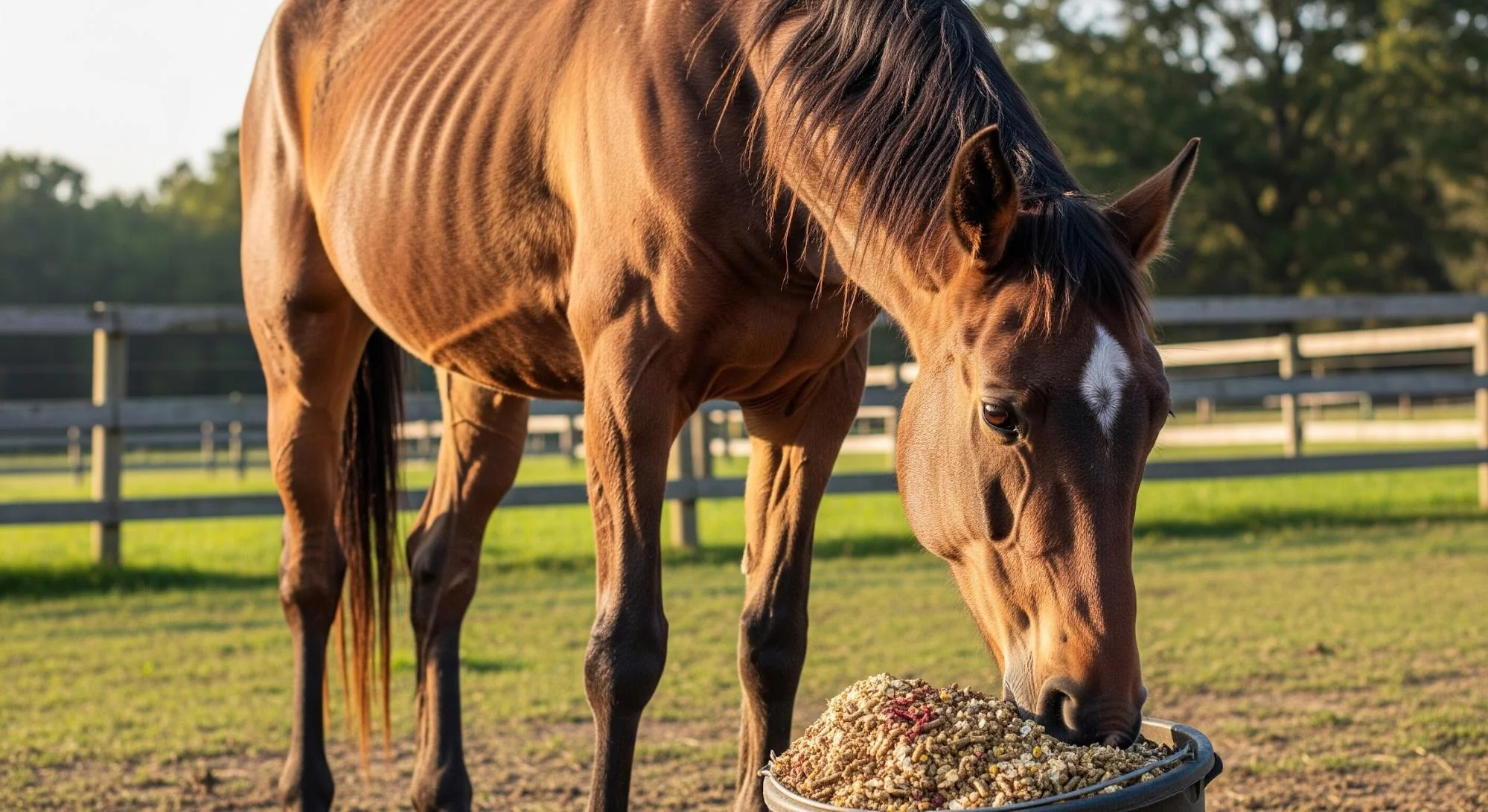
Your senior horse has ribs showing, a sunken topline, and prominent hip bones. You’ve tried extra hay, supplements, and expensive grain—nothing works. The question keeping you up: “what is the best feed for an old skinny horse?”
This guide provides actionable, science-based answers to restore your horse’s weight safely.
Why Senior Horses Lose Weight: Understanding the Root Causes
And here is what most articles do not want to say straight out in the very beginning of them: your old horse is not merely eating less, their whole body is playing an invalid game of digestion.
There are three biological challenges that are currently occurring:
Challenge #1 – Dental Problems: The molars which chewed its way through decades died, broke or fell out. Your horse swallows pieces of hay which undigested.
Challenge #2 – Ineffective nutrient absorption: The lining of the intestines is not absorbing nutrients effectively. Even well chewed food absorbs not 80-90 but only 60-70 percent of the available food energy.
Challenge 3 – More Caloric Requirements: The old horse expends more calories to keep the body temperature normal and to sustain the basic functions. Combine winter weather or Cushing disease and they require MORE food yet they are able to process LESS.
How to Know If Your Horse Is Actually Underweight
Visual indicators: Ribs easily visible, prominent hip bones, sunken tailhead, visible spine, sharp shoulders, thin neck, angular rump.
Body Condition Scoring (1-9 Scale):
| Score | Condition | Action Needed |
| 1-2 | Emaciated | Emergency intervention |
| 3-4 | Thin | Immediate feeding program required |
| 5-6 | Moderate | Ideal target range |
| 7-9 | Overweight | Reduce calories |
Target maintaining BCS 5-6 for healthy senior horses.
Now that you understand why traditional feeding fails, let’s fix this.
What Is the Best Feed for Old Skinny Horse: Essential Nutritional Requirements
Forget everything you think you know about equine feed. Senior horses need a completely different playbook.
Top 4 Ingredients in the Best Feed for Old Skinny Horses
#1 – Pre-Chewed Fiber: Your horse needs fiber that’s already broken down—beet pulp, soy hulls, wheat middlings. These bypass dental problems and feed hindgut bacteria that produce energy.
#2 – High Fat Content: Fat delivers 2.25 times more calories per bite than carbs. Look for stabilized fats (rice bran, flaxseed, vegetable oil) with 8-12% fat content minimum.
#3 – Low Starch (Under 15%): High starch feeds create blood sugar spikes and inflammation. Low starch horse feed for seniors delivers calories WITHOUT metabolic stress—essential for preventing laminitis or managing Cushing’s.
#4 – Quality Protein (14-16%): Maintains existing muscle tissue and prevents the body from cannibalizing muscle for energy.
Complete Feed vs Regular Feed: What Works Best for Senior Horses

When your horse gets a score of less than 4 on body condition (ribs and hip bones apparent), he or she requires a full diet, that is, it can substitute hay. These feeds are forage which is combined with concentrate, vitamins and minerals.
Why? Older horses that have dental problems are unable to eat adequate amounts of normal hay to obtain the necessary calories. A full feed condenses that food into 15-20 pounds of food that is easily-digestible and soaked.
How Much to Feed a Senior Horse: Calculating Daily Portions
Stop guessing. Here’s how to feed an old horse by actual numbers:
| Horse Weight | Daily Feed (Weight Gain) | Number of Meals |
| 800 lbs | 20-24 lbs | 3-4 meals |
| 1,000 lbs | 25-30 lbs | 3-4 meals |
| 1,200 lbs | 30-36 lbs | 4 meals |
The 2.5% Rule: For weight gain, feed 2.5-3% of body weight daily. An 1,000 lb horse needs 25-30 lbs total feed. Split into multiple meals—their digestive system can’t handle massive portions anymore.
How to Feed an Old Horse: 12-Week Weight Gain Protocol
Phase 1: Foundation (Week 1-2)
Daily Feeding Schedule: Morning: 4-5 lbs senior feed (soaked), 1 lb beet pulp, 1/4 cup fat supplement Midday: 3-4 lbs senior feed (soaked) Evening: 5-6 lbs senior feed (soaked), 1 lb beet pulp, 1/4 cup fat supplement Late Night: 2-3 lbs senior feed (soaked)
Watch manure consistency, water intake, and energy levels.
Phase 2 & 3: Acceleration and Maintenance (Week 3-12)
Weeks 3-6: Increase fat to 1/2 cup per meal. Add 1-2 lbs per feeding. Target 1-2 lbs weekly weight gain.
Weeks 7-12: Monitor body condition score. Maintain feed when BCS improves. Reduce to maintenance levels once BCS 5 is reached.
If no improvement by week 12, underlying medical issues require veterinary intervention.
Should I Feed My Horse Grain? Why Traditional Grain Isn’t Best for Seniors
People ask “should i feed my horse grain” when facing weight loss. The truth: traditional grain is wrong for senior horses.
Grain = high starch + hard kernels + glucose spikes. Seniors with dental issues can’t chew properly. Starch triggers metabolic chaos and appetite crashes.
Modern senior feeds are engineered nutrition—digestible forms with controlled starch and added fat. Science-based feeding beats throwing corn at the problem.
Best Feed Products for Underweight Senior Horses: Shopping Guide
Base Feed: Senior complete feed pellets (14%+ protein, 8%+ fat, <15% starch)
Calorie Boosters: Unsweetened beet pulp, stabilized rice bran or ground flaxseed
Digestive Support: Alfalfa pellets, probiotic supplement
Avoid: Sweet feed, whole corn/oats, generic feeds, molasses-heavy products
Recommended Products for Old Skinny Horses
If you’re looking for specific feed options, here are the products that actually work for underweight senior horses:
Southern Supreme Senior (Top Choice) Specifically formulated for senior and geriatric horses—the ideal solution when asking what is the best feed for old skinny horse. Softer texture addresses dental issues. Can be fed as sole ration for horses unable to eat hay, or soaked into mash for easier swallowing.
Ener-G-Plus 12/10 Low-Starch (Excellent Alternative) With 10% fat and high fiber, this low starch horse feed for seniors delivers concentrated calories without metabolic risks. Designed for “hard-keepers” and metabolically challenged horses. Perfect for seniors with insulin resistance or Cushing’s disease.
How to Use These Products: Feed Southern Supreme Senior as base (2.5-3% body weight). Soak with warm water (2:1 ratio) for 15-20 minutes until mash consistency. Add Ener-G-Plus for extra calories. Split into 3-4 meals daily.
For beet pulp: 4:1 water ratio, soak 30 minutes minimum.
7-Day Transition: Days 1-2 (75% old/25% new), Days 3-4 (50/50), Days 5-6 (25% old/75% new), Day 7+ (100% new). Watch manure—loose stool means slow the transition.
Products to Avoid: Performance feeds, race formulas, mare/foal feeds, sweet feeds, and whole grain mixes. Wrong nutritional profiles and too hard for senior teeth.
Additional Care Factors for Senior Horse Weight Gain
Dental Reality: Get teeth floated every 6 months. Sharp points prevent proper chewing and waste feed.
Parasite Drain: Senior horses need strategic deworming. Worms steal nutrients.
Temperature Tax: Cold weather burns extra calories. Blanket and provide shelter.
Social Stress: Bullied horses don’t eat enough. Separate feeding if needed.
Key Supplements for Senior Horse Recovery
Vitamin E (2,000-4,000 IU daily): Muscle/nerve support. Use natural (d-alpha tocopherol) forms.
Probiotics: Live yeast cultures improve digestion and gut health.
Joint Support: Glucosamine and MSM improve mobility for comfortable eating.
B-Complex: Supports appetite in picky eaters.
Add one supplement at a time over 2-3 weeks. Consult vet before combining with medications.
When to Call a Veterinarian: Warning Signs in Underweight Horses
Stop everything and get professional help if you see:
- Weight loss continues after 4 weeks of proper feeding
- Feed refusal lasting more than 24 hours
- Chronic diarrhea or colic symptoms
- Excessive water drinking
- Severe lethargy
- Body condition score drops to 2 or below
Medical Conditions That Cause Weight Loss in Seniors
Sometimes weight loss isn’t about feed—it’s about underlying disease requiring veterinary diagnosis:
PPID (Cushing Disease): Long curly hair which fails to shed, high drinking/urination, laminitis, pot belly accompanied by muscle wasting. Requires drug (pergolide) and low starch horse food that seniors require.
Kidney Disease: Anorexia, polyuria, polyuria, bad coat. Demands special low-protein diets- normal elderly food can be unsuitable.
Dental disease: Abscesses, fractured or tumor in teeth lead to excruciating pain. Symptoms are quidding (dropping food), tilting of the head during food intake, foul breath.
Chronic Pain: Arthritis or laminitis decreases locomotion and appetite. The changes in feeding should be preceded by pain management.
Cancer: Reduction in weight, fever, swellings, lymph nodes, which are enlarged signal the possibility of lymphoma and other cancers.
Which is the most appropriate feed of skinny old horse? It does not matter whether there is untreated disease. Seek medical diagnosis.
Realistic Timeline for Senior Horse Weight Gain
Healthy weight restoration takes 3-6 months minimum. Aim for slow, steady gain of 1-2 lbs weekly. Rapid weight gain causes digestive upset and metabolic stress.
Your horse took years to reach this condition. Reversing it safely requires patience and consistency.
Budget Reality: Monthly Feeding Costs
Monthly Investment (1,000 lb horse): Senior feed: $200-300 | Beet pulp: $30-50 | Fat supplements: $40-60 | Probiotics: $30-50 Total: $300-460/month (vs. $100-150 for maintenance)
Saving Strategies: Buy bulk for 10-15% savings. Share orders with other owners. Use quality generic feeds. Reduce portions after reaching target weight.
Proper feeding costs less than treating malnutrition complications.
Summary: Choosing the Best Feed for Your Old Skinny Horse
Which is the best feed, old skinny horse? Complete feed with 14%+ protein and 8%+ fat that contains less than 15% starch, fed 2.5-3% of body weight per day, 3-4 soaked meals with the addition of beet pulp and stabilized fats that are seniors specific.
How should one feed an aged horse? More than you imagine- Generally 25-30lbs per day on an 1000 lb horse that requires weight gain.
Start today. Find good quality senior food, wet it, feed and feed several times per day, treat dental problems, and invest 12 weeks. To monitor slow progress, take photos weekly.
Your horse had bestowed upon them their prime years. Give them now the nutrition that they require to age with dignity and health.
FAQs
1. What is the best feed for an old skinny horse?
The best feed is a senior-specific complete feed with 14%+ protein, 8%+ fat, and under 15% starch. Soaked pellets, combined with beet pulp and stabilized fats, provide digestible calories, support muscle, and bypass dental issues. Split into multiple daily meals to maximize nutrient absorption.
2. How much should I feed a senior horse for weight gain?
Feed 2.5-3% of body weight daily, split into 3-4 meals. For a 1,000 lb horse, this means 25-30 lbs total feed including soaked senior pellets, beet pulp, and fat supplements. Smaller, frequent meals prevent digestive upset and improve nutrient uptake.
3. Can old horses eat regular grain or sweet feed?
No, traditional grain and sweet feed are often too high in starch and hard to chew. They can cause glucose spikes, metabolic stress, and digestive upset. Senior-specific feeds with low starch and pre-chewed fiber are safer and more effective.
4. What supplements help senior horses gain weight?
Supplements like probiotics, stabilized fats (flax or rice bran), vitamin E, glucosamine, and B-complex support digestion, muscle health, and appetite. Introduce one at a time and consult your vet to avoid interactions with medications.
5. How long does it take for a senior horse to regain weight?
Healthy weight gain in senior horses is slow and steady, typically 1-2 lbs per week. Expect 3-6 months for noticeable improvement. Rapid gain risks digestive upset and metabolic complications, so consistency and monitoring are essential.