 Dogs & Cats
 Cattle
 Equine
 Poultry
 Swine
Swine Goats & Sheep
 Game Bird
 Gamecock
 Deer & Wildlife
 Fish & Pond
 Rabbit
 Specialty
 Ingredients & Bulk
 Special Order

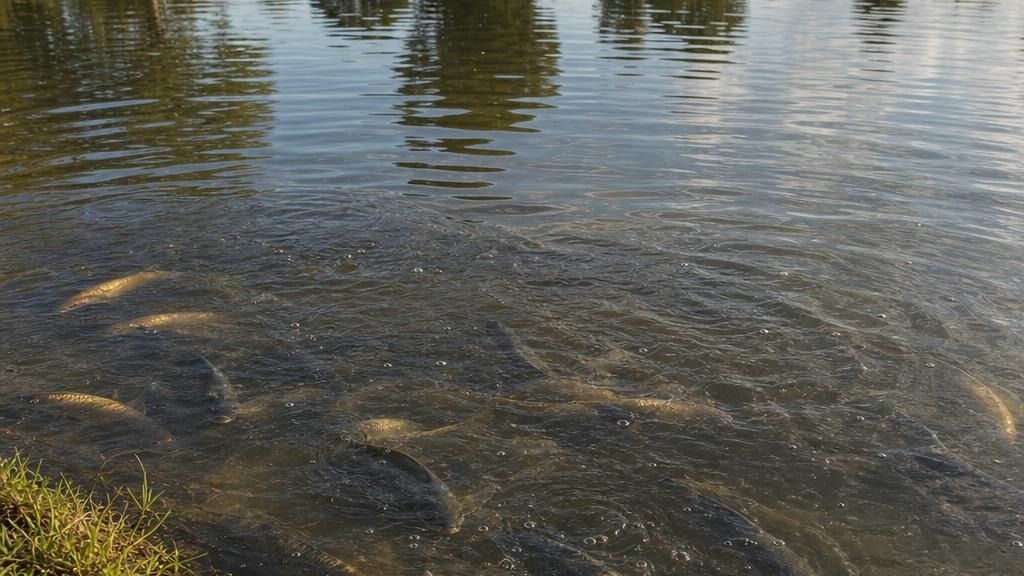
A feeding chart can estimate what pond fish might eat, but the fish and the water give the final answer each day. Their response changes with temperature, weather, oxygen, fish size, and recent feeding. Learning to read that response helps you avoid two opposite mistakes: repeatedly feeding an empty pond or throwing in more than the fish can finish.
This approach is especially useful in a recreational pond where the exact number and weight of fish are unknown. Floating feed becomes both nutrition and an observation tool. You can see where fish gather, how quickly they begin, whether smaller fish get access, and how much remains.
Build a Consistent Feeding Station
Feed from the same accessible area at roughly the same time when conditions are suitable. Consistency helps fish learn the routine and makes your observations easier to compare. Choose a location where you can see the surface clearly and retrieve or observe leftover feed. Avoid a bank where wind immediately sweeps pellets into weeds.
Use a floating feed with a pellet size the fish can readily take, and follow the product's species and feeding directions. Store it cool and dry so each feeding starts with fresh, sound feed. The fish and pond feed page can help you compare feed forms intended for pond use.
Watch the First Minute
Scatter a small amount over the feeding area, then pause. A normal, eager response often begins promptly once trained fish notice the feed. Look beyond the biggest splashes:
- Are fish arriving throughout the feeding area or only at one crowded point?
- Do they take pellets cleanly, or mouth and reject them?
- Are several fish sizes participating?
- Does activity build, remain steady, or fade almost immediately?
- Are pellets drifting untouched toward shore?
Add feed in small rounds while fish continue taking it actively. This is easier to control than throwing the full amount at once. Mississippi State Extension's general pond guidance is never to offer more than fish consume within about 5 to 10 minutes because uneaten feed can harm water quality.
Know When the Meal Is Finished
The stop signal is not the last dramatic splash. It is the point when active feeding clearly slows and pellets begin lingering. End the meal while leftovers are minimal. More feed after interest fades does not make fish grow faster; it adds cost and organic matter to the pond.
Use a marked scoop and record the amount offered. Over several feedings, the notes reveal a normal range for current conditions. They also make a sudden change easier to recognize. Do not keep increasing the amount simply because fish finished yesterday's ration quickly; adjust in measured steps and continue observing.
A Weak Response Is Information
If trained fish that normally feed well do not respond, stop adding feed and investigate. Common influences include rapid weather changes, unsuitable water temperature, low dissolved oxygen, poor water quality, disturbance, or a fish health problem. A missed meal is less damaging than loading the water with uneaten feed.
Pay Attention to Oxygen Clues
Warm water holds less dissolved oxygen than cool water, and oxygen is often lowest around dawn. Fish gathering at the surface and appearing to gulp air is not a request for feed. Stop feeding and seek appropriate pond-management help. Persistent poor response, unusual swimming, or dead fish also calls for prompt evaluation by a fisheries professional.
Heavy cloud cover, a sudden plant or algae die-off, and several still, hot days can change pond conditions. Feeding decisions should respond to the pond you see today rather than a rigid calendar.
Separate Feeding Response From Population Estimates
Surface activity does not provide an exact fish count. Some species and larger individuals dominate a feeding station, while others remain deeper or feed at different times. If only a few large fish take all the pellets, changing distribution along the bank may improve access, but stocking balance and harvest decisions require broader pond assessment.
Likewise, an automatic feeder does not remove the need to observe. Check its throw pattern, timer, feed condition, and the pond's response regularly. Wind or a blocked spinner can place feed where fish cannot use it.
Keep a Simple Pond Feeding Log
- Date, time, and approximate weather conditions.
- Amount and type of feed offered.
- Minutes of active feeding.
- Whether pellets remained and where they collected.
- Unusual fish behavior or changes in water appearance.
- Any feeder adjustment, harvest, or aeration event.
The log does not need to be elaborate. A weatherproof notebook near the feed container can show seasonal patterns and help multiple caretakers avoid duplicate meals. It also gives an Extension fisheries specialist better context if a problem develops.
Let Observation Set the Pace
A reliable routine is simple: begin with a small amount, watch closely, add in rounds, and stop as the response slows. Skip feeding when conditions are unsuitable or fish suddenly refuse the meal. That protects water quality while keeping the feeding program responsive to the pond.
If you need a floating feed in an appropriate pellet size after reviewing your pond plan, ask a local feed professional about available options. You can find nearby retailers through the dealer locator.