 Dogs & Cats
 Cattle
 Equine
 Poultry
 Swine
Swine Goats & Sheep
 Game Bird
 Gamecock
 Deer & Wildlife
 Fish & Pond
 Rabbit
 Specialty
 Ingredients & Bulk
 Special Order

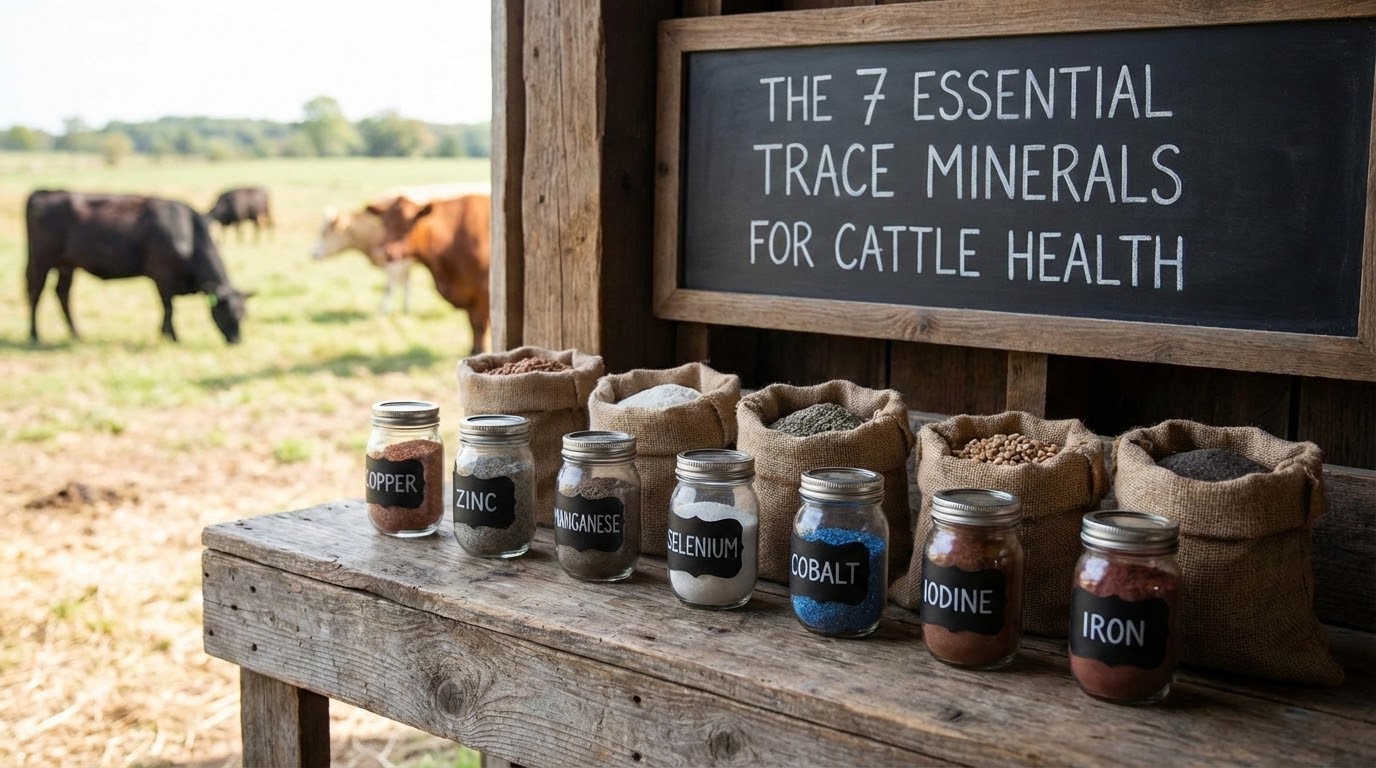
Most cattle producers don’t notice a mineral problem until it’s already costing them money. Poor weight gain, weak calves, low fertility, and silent immune issues often trace back to one thing: missing trace minerals for cattle.
Here’s the reality. Even if your cattle are grazing good pasture or eating high-quality feed, they can still be deficient. Soil depletion, seasonal changes, and forage variability make it nearly impossible to meet mineral needs without proper supplementation.
The fix is straightforward: understand the 7 essential trace minerals every cow needs and provide them consistently through the right mineral supplements for cows.
What Are Trace Minerals for Cattle and Why Do They Matter?
Trace minerals are nutrients cattle need in small amounts, but their impact is massive. According to research from the National Academies of Sciences, trace minerals directly influence:
- Immune response
- Reproductive performance
- Growth and weight gain
- Milk production
- Hoof and bone strength
Without the right balance, even the best animal feed won’t deliver results.
1. Zinc: The Foundation of Immunity and Skin Health
Zinc is one of the most critical minerals for cattle, especially for maintaining skin, hoof integrity, and immune defense.
Why it matters:
- Supports wound healing
- Prevents hoof cracking and foot rot
- Improves coat condition
Deficiency signs:
- Rough hair coat
- Slow healing wounds
- Increased infections
Dr. Rick Rasby, Beef Nutrition Specialist at the University of Nebraska–Lincoln, notes that zinc deficiency often goes unnoticed until performance drops significantly.
2. Copper: Fertility and Growth Booster
Copper plays a central role in reproduction and growth, making it essential in any cattle mineral supplements program.
Benefits:
- Enhances fertility in both cows and bulls
- Supports proper bone development
- Strengthens immune function
Watch out for:
- Infertility
- Faded coat color
- Poor growth rates
Copper absorption can be blocked by other minerals like molybdenum, which makes balanced supplementation crucial.
3. Selenium: Small Amount, Big Impact
Selenium is often deficient in many regions due to low soil levels. It’s one of the most researched trace minerals for cattle.
Key roles:
- Prevents white muscle disease in calves
- Supports reproductive health
- Boosts immune response
According to the USDA, selenium deficiency is linked to increased calf mortality and weak newborns.
Important note: Selenium must be carefully balanced—too little is harmful, but too much can be toxic.
4. Manganese: Reproduction and Bone Development

Manganese is often overlooked but essential for proper skeletal growth and reproduction.
Why it matters:
- Supports embryo development
- Improves conception rates
- Aids cartilage and bone formation
Deficiency signs:
- Poor fertility
- Weak calves
- Skeletal abnormalities
If you’re struggling with breeding performance, this mineral might be part of the problem.
5. Cobalt: Essential for Energy Production
Cobalt helps cattle produce vitamin B12 in the rumen, which is critical for energy metabolism.
Benefits:
- Improves feed efficiency
- Supports appetite and digestion
- Enhances energy levels
Without enough cobalt, even high-quality cattle mineral feed won’t translate into growth.
6. Iodine: Metabolism and Thyroid Health
Iodine regulates thyroid hormones, which control metabolism.
Key functions:
- Maintains metabolic rate
- Supports reproductive health
- Prevents goiter in calves
Deficiency signs:
- Stillbirths
- Weak calves
- Enlarged thyroid gland
This is especially important for pregnant cows.
7. Iron: Oxygen Transport and Growth
Iron is essential for blood health and oxygen transport.
Why it matters:
- Prevents anemia
- Supports growth and energy
- Critical for young calves
While most cattle get enough iron naturally, stress or disease can increase requirements.
How Do You Know If Your Cattle Need Mineral Supplements?
This is where many producers go wrong. They wait for visible symptoms.
Instead, ask:
- Are my cattle reaching expected weight gains?
- Are conception rates where they should be?
- Do calves look strong at birth?
If the answer is no, your minerals for cows program likely needs improvement.
What Is the Best Mineral Supplement for Cattle?
There’s no single answer. The best mineral supplements for dairy cattle or beef cattle depend on:
- Soil mineral profile
- Forage quality
- Production goals (milk vs. meat)
- Season and grazing conditions
That said, a high-quality supplement should include all 7 trace minerals in balanced, bioavailable forms.
Practical Options from Midsouth Feeds
For producers looking for reliable quality feed for cattle, these options are built for real-world performance:
- Hi-Mag Grazing Mineral – Ideal for preventing grass tetany during lush grazing
- 14-1-14 Winter Grazer Mineral – Supports cattle through cold stress
- All Purpose Mineral – Balanced everyday solution
- 20% MVP Mineral – High-performance formulation
- Breeder Cattle Mineral – Designed for reproductive efficiency
These blends are designed to complement your base animal feed and fill nutritional gaps effectively.
Should You Use a Mineral Feeder for Cattle?
Yes—consistency is everything.
A proper mineral feeder for cattle ensures:
- Free-choice access
- Reduced waste
- Steady intake across the herd
Without it, even the best cattle trace mineral mix won’t deliver results.
Common Questions About Trace Minerals for Cattle
What are the trace minerals cattle need daily?
Zinc, copper, selenium, manganese, cobalt, iodine, and iron.
Can cattle get minerals from grass alone?
Not reliably. Soil depletion and seasonal variation make supplementation necessary.
How often should I provide mineral supplements?
Free-choice access year-round is the most effective approach.
Are mineral supplements different for beef and dairy cattle?
Yes. Minerals for beef cattle focus more on growth, while dairy cattle require additional support for milk production.
The Real Difference: Balanced Nutrition vs. Guesswork
Most cattle operations don’t fail because of major mistakes. They lose performance slowly through small nutritional gaps.
Trace minerals are one of those gaps.
The producers who get consistent weight gain, better reproduction, and healthier herds aren’t guessing. They’re managing minerals with precision.
And once you fix that, everything else—from feed efficiency to herd health—starts working the way it should.
If you’re serious about improving herd performance, it might be time to do more than just upgrade your feed program.
Midsouth Feeds is actively partnering with dealers who understand what cattle producers actually need—consistent quality, proven nutrition, and real results in the field. If you’re already connected to local ranchers, feed stores, or livestock operations, this is a practical way to grow your business while delivering products that producers trust.
Becoming a Midsouth Feeds dealer means you’re not just selling animal feed—you’re providing solutions backed by experience, research, and products built for performance.