 Dogs & Cats
 Cattle
 Equine
 Poultry
 Swine
Swine Goats & Sheep
 Game Bird
 Gamecock
 Deer & Wildlife
 Fish & Pond
 Rabbit
 Specialty
 Ingredients & Bulk
 Special Order

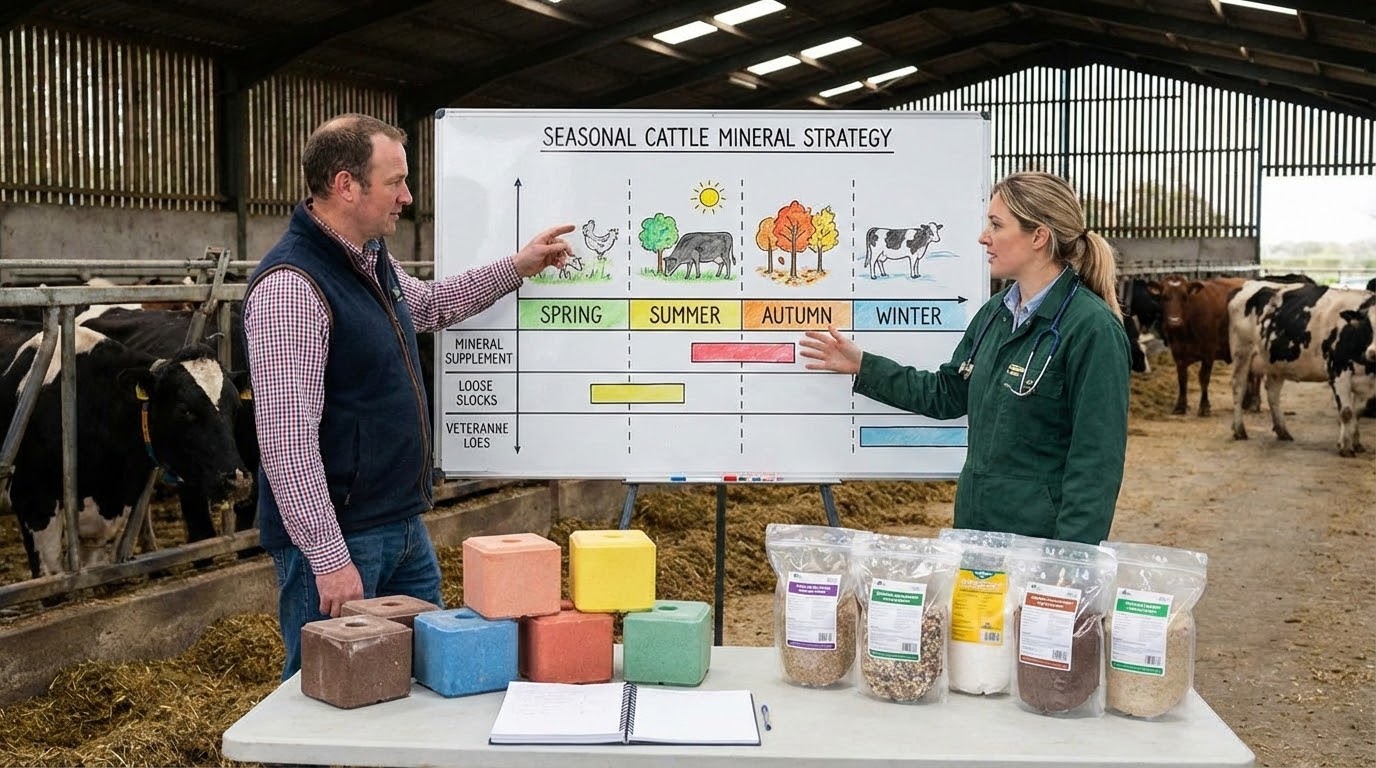
Your cows looked fine last spring. Then calving season hit — retained placentas, weak calves, low conception rates. You ran blood panels. The vet pointed at the numbers: copper and selenium, both critically low.
This is not a rare story. It plays out on beef operations across the country, quietly, every single year. And the frustrating part? Most of it is preventable. The cattle mineral program isn’t the most glamorous part of running a herd, but it may be the highest-leverage decision you make all year.
This guide lays out exactly what your herd needs, when it needs it, how to deliver it, and what happens when you get it wrong — backed by research, not guesswork.
Why Is Cattle Mineral Nutrition So Easy to Get Wrong?
The problem with cattle mineral deficiency is that it rarely looks like a deficiency — at first. There’s no limp, no fever, no obvious sign that something is off. Animals go about their day. Then you notice conception rates slipping, calves that seem just a little slow to stand, or a nagging uptick in respiratory cases.
David Schaeffer, professor at the University of Illinois, and his team analyzed nearly 1,500 liver samples from beef and dairy cattle submitted to the California Animal Health & Food Safety Lab System. Their findings were stark: in beef cattle diagnosed with bovine respiratory disease (BRD), 68% were deficient in copper, selenium, or both. The median age of those animals was just eight months.
The economic hit is real. According to research compiled by Sioux Nation Ag, mild mineral deficiencies cost cattle operations $75–$125 per cow in lost revenue and direct costs. Severe deficiencies push that number to $190–$250 per cow. When you multiply those figures across even a 100-head herd, the math gets uncomfortable fast.
Dr. Hall from Utah State University, who has conducted hundreds of liver biopsies, found that a minor mineral deficiency results in calves weighing 20–35 pounds less at weaning, while severe deficiencies can strip more than 50 pounds per calf off the scale. Those are pounds you never recover.
What Minerals Do Cattle Actually Need?
Cattle need 16 minerals for optimal health, but they fall into two categories that require different management approaches.
Macrominerals — needed in relatively large amounts — include calcium, phosphorus, magnesium, potassium, sodium, and sulfur. Calcium and phosphorus are the structural foundations of bone and muscle. They also govern milk production and reproductive function. Magnesium is essential for nervous system regulation and is the mineral at the center of grass tetany, one of the most sudden and deadly conditions in grazing cattle.
Microminerals (trace minerals) — copper, cobalt, iron, iodine, manganese, selenium, and zinc — are needed in smaller quantities, but their roles are enormous. They drive immune function, enzyme activity, reproduction, and antioxidant pathways. As Dr. Schaeffer’s work at the University of Illinois notes, these trace minerals act as co-factors in metabolic and immune pathways despite making up less than 0.01% of an animal’s body weight.
The three most chronically deficient trace minerals in North American beef herds are copper, selenium, and zinc. And the frustrating part: you often can’t tell by looking at the animal. Subclinical deficiencies — where animals show no obvious clinical signs — are far more common than acute cases and likely cause greater total economic damage, according to a review published in the Journal of Animal Science (Spears and Weiss, 2014).
How Do Mineral Needs Change Throughout the Year?
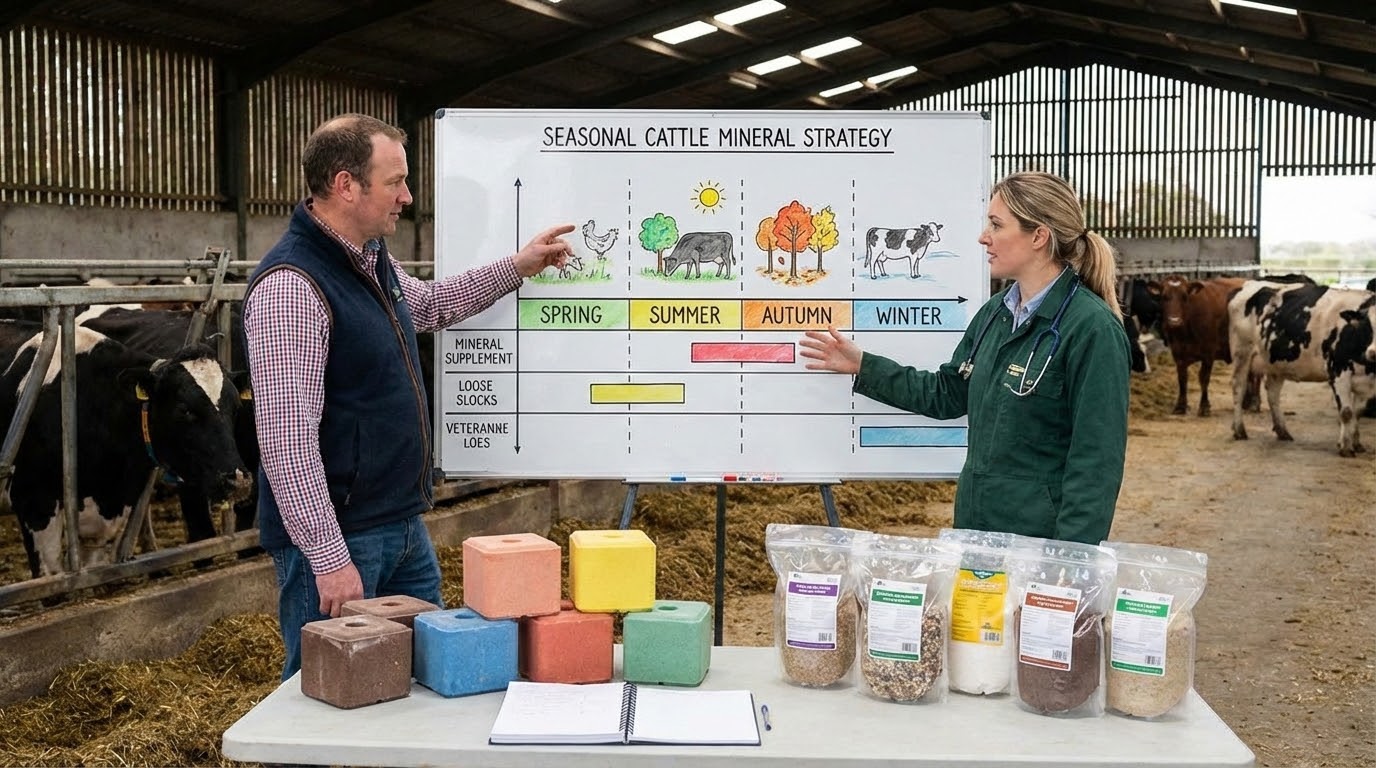
This is where most mineral programs fall short. A static supplement that doesn’t shift with the seasons isn’t really a program — it’s just a box checked.
Spring: Grass Tetany Season and Breeding Prep
Spring grass is one of the most deceptive situations in cattle nutrition. Lush, fast-growing pastures look like ideal feed, and cattle eat it eagerly. But cool, wet conditions reduce a plant’s ability to take up magnesium from the soil. Early spring forages are often deficient in both phosphorus and magnesium, creating the conditions for grass tetany — a condition that can kill a cow within hours of symptom onset.
According to the University of Missouri Extension, lactating cows grazing lush spring pastures are at highest risk. The recommendation is a mineral mix containing 10–14% magnesium oxide, delivered at approximately 4 ounces per head per day. If you’re using blocks, be aware that hard block delivery of magnesium can be unreliable — loose mineral is more dependable during this window.
Spring is also breeding season for many operations. Conception rates are directly tied to trace mineral status. Research cited by Riomax shows that ranchers have documented conception rate increases of 3–10% simply by improving the mineral program. If your herd goes through artificial insemination or embryo transfer, the stakes are even higher, and the quality of the mineral — particularly the bioavailability of trace mineral sources — matters significantly.
Summer: Heat, Parasites, and Inconsistent Intake
Summer brings two challenges. First, cattle consume salt-based mineral supplements more readily in warm months — which sounds like a positive, but it can lead to overconsumption. Extension research out of the University of Nebraska recommends adjusting feeder fill timing in summer: offer mineral every 10–14 days at slightly above target intake levels to prevent gorging when refilled.
The second issue is that summer sicknesses — pneumonia, internal parasites — are often mineral-linked. Dr. Hall of Utah State University found that 90% of the livers he tested from cattle with summer illness showed mineral deficiency. This is the time of year when deficiency and disease intersect most visibly.
For breeding herds, a copper-sufficient program is non-negotiable during this window. Copper is essential for the synthesis of hemoglobin, bone formation, and reproductive success. Sulfur-heavy forages or distillers grain byproducts in the diet can suppress copper absorption significantly, so it’s worth testing your forage if you’re not already.
Fall: Building Reserves Before Winter
This is a transitional window that many producers underutilize. As forage quality drops — corn stalks, stockpiled grass, and lower-quality hay all become part of the diet — mineral content in those feeds decreases as well. Cattle can draw on body stores for a period, but those stores deplete.
According to Purina Animal Nutrition, a practical guideline is to feed a full mineral program beginning 30 days before the last spring frost and continuing 30 days after the last fall frost — a rule of thumb that prevents gaps in supplementation during the most vulnerable transition periods.
Fall is also the time to evaluate your herd’s copper status via liver biopsy if you have concerns. Blood serum is not a reliable indicator for copper — animals can be severely depleted at the tissue level while serum values still read normal. Liver biopsy is the gold standard.
Winter: Intake Drops, Needs Don’t
Free-choice mineral intake can drop by 15% or more in winter months, according to beef mineral research published by Ohio State University. Cattle spend more energy staying warm, are less motivated to travel to feeders, and forages are at their mineral-lowest point.
This is where cattle mineral tubs earn their keep on many operations. A properly formulated mineral tub provides consistent access without requiring cattle to be gathered or fed separately. The density of a quality tub also naturally regulates intake — cattle physically can’t overconsume a well-hardened tub the way they sometimes do with loose mineral.
For pregnant cows in the third trimester, mineral demands increase significantly. The fetus draws minerals from the dam’s reserves. If those reserves are already low going into winter, you set up both the cow and the calf for problems at calving time.
What’s the Best Delivery Method for Cattle Minerals?
There’s no single correct answer — but there are wrong answers, and the wrong answers are common.
Loose mineral offered free-choice is the most widely used method and works well when managed consistently. The target is typically 2–4 ounces per head per day. The key is placement: position feeders near water sources and shaded loafing areas to drive consistent visits. According to University of Georgia Extension, one mineral feeding station per 30–50 cows is the baseline, and feeders should be checked weekly.
Cattle mineral tubs are a practical option, especially for larger pastures, remote grazing, and winter months. They require less labor, resist weather better, and provide more consistent daily intake compared to loose mineral. Cow mineral tubs work by using a hardened medium (often molasses-based) that self-regulates consumption — cattle can lick freely, but the rate at which the tub softens controls how much they actually get. A single mineral tub is suitable for roughly 25–30 head depending on tub size.
What doesn’t work: the “cafeteria” or “buffet” approach — offering individual minerals in separate tubs and expecting cattle to self-select what they need. Research is clear that cattle do not have the nutritional wisdom to correctly balance their own mineral intake from individual sources. They’re driven by salt appetite, not mineral wisdom. When individual minerals are offered separately, palatability problems (magnesium and phosphorus taste terrible to cattle) ensure animals under-consume the minerals they most need.
Mineral mixed into total mixed rations (TMR) is the most precise delivery method for confined operations. For pastured cattle, TMR isn’t practical, making free-choice delivery via loose mineral or tubs the go-to.
Organic vs. Inorganic Trace Minerals: Does It Actually Matter?
The short answer is yes, particularly under stress conditions.
Research from Iowa State University compared organic and inorganic trace mineral supplementation in newly received beef calves. Calves receiving organic trace minerals showed approximately 9–12% better average daily gain compared to those on inorganic sources. A separate University of Arkansas study found that heifers supplemented with inorganic trace minerals had a 58% BRD morbidity rate compared to 46% in heifers on organic sources.
The biological reason: organic trace minerals (bound to amino acid complexes, chelates, or proteinates) are more bioavailable — they’re more readily absorbed and utilized than inorganic forms like sulfates and oxides. When cattle are stressed — during shipping, weaning, or extreme weather — their ability to absorb inorganic minerals drops further. That’s exactly when bioavailability matters most.
For routine supplementation, inorganic sources are often adequate and more economical. But for breeding herds, stressed receiving cattle, or operations with a history of deficiency, investing in organic or complexed trace mineral sources is often worth the cost.
How Do You Know If Your Mineral Program Is Working?
The most reliable indicator is herd performance over time: conception rates, weaning weights, calf health incidence, and cow body condition heading into winter. But those are lagging indicators — by the time they slip, you’ve already lost something.
For a more direct read, liver biopsy is the most accurate diagnostic tool for copper, selenium, manganese, and zinc. It’s more invasive and expensive than blood draws, but blood values — especially for copper — can read normal even when liver stores are significantly depleted.
A practical approach many nutritionists recommend: test 8–10% of your herd with liver biopsies every 1–2 years, targeting animals that have recently calved or gone through high-stress events. Complement this with forage analysis from your specific pastures, which will tell you what minerals your grass is and isn’t providing.
Chris Cassady, Ph.D., Director of Beef Technical Sales at BioZyme, puts it plainly: “Providing cattle with a proper supplement that contains adequate minerals is important, as it serves as an insurance policy for seasonal fluctuations in forage quality and can keep cattle from becoming deficient or imbalanced in energy, protein, or mineral status.”
Frequently Asked Questions
How much mineral should a beef cow consume per day? The general target for loose free-choice mineral is 2–4 ounces (approximately 60–120 grams) per head per day. With mineral tubs, target intake is typically lower — around 1/8 to 1/3 of a pound per head per day depending on the product concentration.
What minerals are most commonly deficient in beef cattle? Copper, selenium, and zinc are the three most frequently identified deficiencies in North American beef herds. Phosphorus deficiency is described as the most prevalent mineral insufficiency in grazing livestock worldwide.
Can cattle get too much mineral? Yes. Selenium toxicity is a real risk and is why FDA regulations cap the concentration of selenium in free-choice mineral mixes. Copper excess can also cause liver damage, particularly in dairy cattle and some breeds. Excess supplementation above requirements adds cost, can create antagonist relationships between minerals, and increases manure excretion of environmentally sensitive minerals.
Are mineral tubs enough on their own? For many pasture operations, quality cattle mineral tubs provide consistent, reliable nutrition — particularly through winter and in extensive grazing systems. The key is choosing a tub formulated with all 14 essential minerals at the correct ratios, not just salt and a trace mineral blend.
The Bottom Line
A sound cattle mineral program isn’t just an input cost — it’s a performance multiplier. The research from Ohio State, Iowa State, the University of Arkansas, and independent diagnostic labs all points in the same direction: deficiency is common, often invisible, and expensive. Correction is straightforward when done consistently and with the right products.
That means matching your supplement to the season, placing feeders where cattle actually go, choosing delivery methods that guarantee consistent intake, and treating mineral status as something you verify — not assume. Whether you’re managing a 50-cow cow-calf operation or a large beef feedlot, the principle is the same: you can’t optimize what you don’t measure, and you can’t afford to wait until the herd tells you something is wrong.
For animal livestock feed solutions tailored to your region and your herd, including cow feed and year-round mineral programs, Midsouth Feeds carries the products and the expertise to build a program that works. If you’re searching for animal feed dealers near me, start with people who know what’s actually in the soil — and the forage — where your cattle graze.
Sources: Journal of Dairy Science (Weiss & Hall, 2024); PubMed / Journal of Animal Science (Spears and Weiss, 2014); NIH / PMC – Trace Mineral Nutrition of Grazing Beef Cattle; Ohio State University Beef Mineral Guide; University of Missouri Extension (G2081); University of Georgia Cooperative Extension (B895); Oklahoma State University Beef Cattle Research Update (2024); Iowa State University feedlot trace mineral trial (Smerchek et al., 2023); University of Arkansas (Cheek et al., 2024); Sioux Nation Ag Mineral Deficiency Economics; Purina Animal Nutrition Mineral Guidance; BioZyme / VitaFerm Protein Tub Research; Riomax field research and Dr. Hall liver biopsy data (Utah State University).