 Dogs & Cats
 Cattle
 Equine
 Poultry
 Swine
Swine Goats & Sheep
 Game Bird
 Gamecock
 Deer & Wildlife
 Fish & Pond
 Rabbit
 Specialty
 Ingredients & Bulk
 Special Order

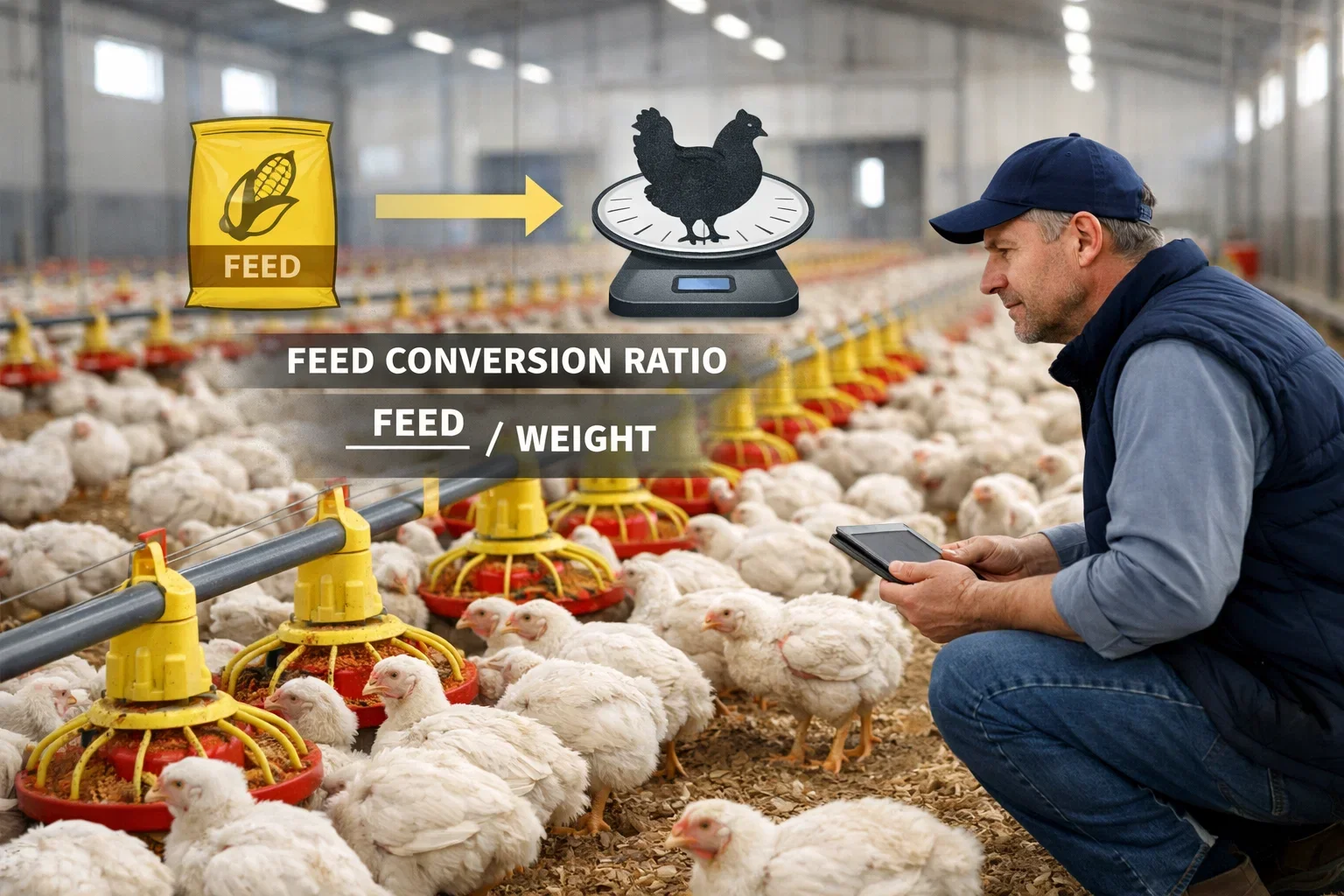
One of these is the feed conversion ratio that is a very important performance indicator in poultry farming today. Raising broilers, layers or turkeys, you can determine profitability of your whole business directly by how effectively you feed your birds to recognize their body weight. This guide contains all the information you require about FCR in poultry including its fundamental definition and its actionable practical strategies in enhancing the same in your farm.
Definition of Feed Conversion Ratio
The definition of the feed conversion ratio is the quantity of feed an animal consumes in relation to the body weight incremented in a specific span of time. It will inform you of the exact amount of kilograms of feed needed to gain one kilogram of live weight. A low FCR means high feed efficiency, thus the money spent on feed per kilogram of bird produced is less.
The formula every poultry farmer should know:
FCR = Total Feed Consumed (kg) ÷ Total Weight Gained (kg)
To illustrate the above, an example is that when your broiler flock feeds 4,000 kg of feed and gains 2,000 kg of body weight throughout the grow-out period, your FCR is 2.0. The quantity of this number alone speaks a lot regarding the nutrition of your flock, the level of their health, and the quality of farm management in general.
Why FCR Is the Most Important Metric in Poultry Farming
In the majority of poultry operations globally, feed expenditure is 60-70 percent of the total production costs. This fact makes FCR the heart of the profitability strategy of all the producers. Even a small change in FCR like 2.0 to 1.85 will create savings when it is applied at a scale of thousands of birds and at several production cycles a year.
FCR also serves as an indirect indicator of several other critical farm performance areas:
- Flock health status sick or stressed birds eat less and grow more slowly, pushing FCR upward
- Feed quality and formulation poor nutrient density forces birds to eat more to meet their biological needs
- Housing and environmental management temperature, ventilation, and litter quality all influence how birds use their feed
- Water access and quality inadequate water reduces feed intake and slows growth simultaneously
- Genetic potential the breed you choose sets the ceiling for what FCR is achievable on your farm
Tracking FCR consistently gives you early warning signals before problems become expensive, allowing you to intervene at the right time with the right solution.
What Is a Good FCR in Poultry?
What is a good FCR in poultry is a question every producer asks, and the honest answer is that it depends on the type of bird and the production system in place. However, industry benchmarks give farmers a reliable reference point to evaluate whether their flock is performing at, above, or below the standard for their category.
FCR Benchmarks by Poultry Type
| Poultry Type | Good FCR Range | Excellent FCR |
| Broilers (Meat Chickens) | 1.6 – 1.9 | Below 1.6 |
| Layer Hens (Eggs) | 2.0 – 2.5 | Below 2.0 |
| Turkeys | 2.5 – 3.0 | Below 2.5 |
| Ducks | 2.2 – 2.8 | Below 2.2 |
Modern commercial broiler breeds have been selectively developed over decades specifically to achieve remarkable feed efficiency. A well-managed broiler flock today can reach an FCR as low as 1.5 under optimal conditions, a figure that was considered extraordinary just a generation ago.
Fact: Poultry science research confirms that modern commercial broilers have improved their FCR by nearly 50 percent over the past five decades, driven by advances in genetics, precision nutrition, and farm management technology.
Broiler FCR Meaning: Reading the Numbers Correctly

Broiler FCR meaning extends well beyond a number recorded at the end of a production cycle. In commercial broiler production, FCR is tracked on a weekly and sometimes daily basis so that performance drops can be identified and addressed before they escalate into serious losses.
Here is what different FCR ranges typically signal in a broiler flock:
- FCR below 1.6 Exceptional performance; optimal genetics, feed formulation, and management are all working together
- FCR 1.6 to 1.9 Solid industry-standard performance with room for incremental improvement
- FCR 1.9 to 2.2 Below average; investigate feed palatability, disease pressure, or environmental stressors
- FCR above 2.2 A significant concern that warrants an immediate and thorough review of all management practices
Regular FCR monitoring empowers farmers to make confident, data-driven decisions at every stage of the production cycle rather than discovering problems only at slaughter.
Feed Efficiency vs Feed Conversion Ratio: Knowing the Difference
The terms feed efficiency and feed conversion ratio are often used interchangeably on the farm floor, but feed efficiency vs feed conversion ratio are technically two distinct measurements that look at the same data from opposite directions.
Feed Conversion Ratio (FCR) measures how much feed is required per unit of weight gained. A lower number means better performance.
Feed Efficiency (FE) measures how much weight is gained per unit of feed consumed. A higher number means better performance.
| Metric | Formula | Better Performance |
| Feed Conversion Ratio | Feed Consumed ÷ Weight Gained | Lower is better |
| Feed Efficiency | Weight Gained ÷ Feed Consumed | Higher is better |
Most commercial poultry producers prefer FCR because it aligns naturally with cost-per-kilogram thinking and is easier to apply in day-to-day farm decision-making. Nutritionists and researchers, on the other hand, sometimes favor feed efficiency because it frames the bird’s biological performance in a more positive and intuitive way.
Key Factors That Determine FCR in Poultry
The results of FCR are driven by a few factors that are interrelated in a farm that keeps poultry. Knowing all of them assists producers in determining the largest areas where their improvement should be focused to be achieved in their production.
1. Genetics and Breed Selection

Commercial breeds like Ross 308 and Cobb 500 have been developed with a higher level of feed efficiency through many generations of breeding. The most fundamental decision that you will make with regards to FCR performance is the choice of the right breed to use in your production system.
2. Feed Quality and Nutritional Balance
A well-designed feed that has the appropriate ratio of protein, energy, amino acids, vitamins, and minerals enables the body of the bird to utilize the nutrients in the most efficient way. Low-grade raw material or inappropriate formulations compel the birds to eat a lot of feed yet gain little weight, which is a direct inflation of FCR.
Key nutritional factors that influence FCR include:
- Digestible lysine and methionine levels matched to growth phase
- Correct energy-to-protein ratio across starter, grower, and finisher diets
- Consistent pellet quality to reduce feed wastage at the feeder
- High-quality, traceable raw material sourcing throughout the supply chain
3. Water Quality and Continuous Availability
The least estimated nutrient in poultry production is water. Birds that do not get regular access to clean and fresh water will lower their feed consumption virtually overnight, slowing growth and sending FCR in the negative direction. In the course of all production cycles, water lines have to be inspected, flushed and maintained regularly.
4. Flock Health and Biosecurity
One of the most destructive and fastest ways of destroying FCR performance is through disease. The respiratory infections, coccidiosis, and necrotic enteritis all shift the metabolic energy of the bird towards growth and immune response and raise considerably the amount of feed per pound of gain. An effective biosecurity program with a well-designed schedule of vaccination will save FCR expensive and preventable health losses.
5. Environmental Management Inside the House
The combination of temperature, humidity, ventilation and lighting have an effect on feed intake and growth rate. It also has temperature ranges that broilers need where variations between them in either way have quantifiable effects on FCR with an increase or decrease in age.
Fact: It has been shown that a change in temperature by as little as 3 o C higher or lower than the perfect range of broiler comfort can raise the FCR by 0.05 0.10 point which is a big cost burden when multiplied by a complete production cycle and thousands of broilers.
Practical Strategies to Improve FCR on Your Farm
Improving FCR does not always require major capital investment. Many of the most effective improvements come from better observation, consistency in daily routines, and smarter use of the data you already have.
- Track FCR every week, not just at the end of the cycle, to catch performance drops early
- Calibrate all feeding equipment regularly to ensure accurate delivery and minimize feeder wastage
- Apply phase feeding programs that match nutrient density precisely to each stage of bird growth
- Maintain proper drinker height and pressure to encourage consistent water intake throughout the day
- Control stocking density carefully to reduce competition for feed and water among birds
- Audit your feed supplier regularly to verify raw material quality and batch-to-batch consistency
- Record and compare FCR data across production cycles to identify trends and target specific weak points
Small and consistent improvements compound meaningfully over time. A farm that reduces its average FCR from 2.0 to 1.85 across three consecutive cycles has achieved a genuine competitive advantage in its market.
The Role of Premium Feed in Reaching Your FCR Goals
No management practice, no matter how disciplined, can fully compensate for poor feed quality. The foundation of excellent FCR is a well-formulated, consistently produced feed made from reliable, high-quality ingredients. Working with a poultry feed supplier that understands poultry nutrition science and that delivers batch-to-batch consistency removes one of the most significant variables from your FCR equation and gives every other management effort a stronger foundation to build upon.
Conclusion
Feed conversion ratio is much more than a technical measure that is measured at the end of an output cycle. It is a live look into the health, efficiency and profitability of your complete operation of the poultry. Learning the meaning of FCR, keeping it within the desired range, and implementing specific corrective measures at the time when it starts to drift will help farmers to lower the overall cost of production significantly and produce more competitive and healthy flocks on a seasonal basis.
If you are ready to take your flock’s FCR performance to the next level, starting with a trusted, science-backed feed is the smartest investment you can make. Mid South Feeds has been supporting poultry producers with premium, nutritionally balanced animal feeds designed for real farm conditions and genuine performance results. Their products are formulated with the precision and consistency that serious FCR improvement demands, making them a natural partner for producers who want measurable outcomes.
You can find quality Mid South Feeds products near you through their convenient dealer locator, or if you are passionate about connecting farmers with better nutrition solutions, explore what it means to become an animal feed dealer in your community. Better FCR starts with better feed and better feed starts with the right partner by your side.
FAQs
1. Why is FCR important in poultry farming?
FCR directly impacts profitability since feed accounts for most production costs. Better FCR means lower feed expenses and higher returns for farmers.
2. How do you calculate FCR in poultry?
FCR is calculated by dividing total feed consumed by total weight gained. A lower value indicates better feed efficiency and performance.
3. What is a good FCR for broilers?
A good broiler FCR typically ranges between 1.6 and 1.9. Values below 1.6 are considered excellent under optimal conditions.
4. What factors affect FCR in poultry?
Key factors include genetics, feed quality, water availability, and flock health. Environmental conditions like temperature and ventilation also play a major role.
5. How does feed quality impact FCR?
High-quality, balanced feed improves nutrient absorption and growth rate. Poor feed forces birds to eat more, increasing FCR and reducing efficiency.