 Dogs & Cats
 Cattle
 Equine
 Poultry
 Swine
Swine Goats & Sheep
 Game Bird
 Gamecock
 Deer & Wildlife
 Fish & Pond
 Rabbit
 Specialty
 Ingredients & Bulk
 Special Order


Feeding a flock efficiently is what separates a profitable poultry operation from one that constantly struggles with rising feed costs. Every kilogram of feed either contributes to productive output or quietly erodes your margin and the difference comes down to one critical number: your Feed Conversion Ratio.
Understanding how to calculate feed efficiency in poultry gives you the clarity to act on real data, catch problems early, and finish every cycle stronger. This guide covers everything you need from the core formula and benchmarks to proven strategies for improvement.
What Is Feed Efficiency in Poultry?
Feed efficiency in poultry refers to how effectively a bird converts the poultry feed it consumes into a useful output whether that is body weight in broilers or eggs in layers. It is one of the most important performance indicators in commercial poultry production and directly affects profitability at every stage of the operation.
Understanding what is feed efficiency in chickens helps producers identify where feed resources are being utilized well and where adjustments are needed. A bird that gains more weight per kilogram of feed consumed is considered more feed-efficient than one that requires a higher feed input for the same output.
This metric is influenced by genetics, feed quality, bird health, management practices, and environmental conditions making it a true reflection of the overall operation.
The Feed Conversion Ratio (FCR): The Core Formula
The most widely used method to measure feed efficiency is the Feed Conversion Ratio (FCR). It is a simple yet powerful number that tells you how much feed is required to produce one unit of live weight gain or one dozen eggs.
The formula for FCR is straightforward:
FCR = Total Feed Consumed (kg) ÷ Total Weight Gained (kg)
For example, if a flock of broilers consumes 2,000 kg of feed and gains 1,000 kg in body weight, the FCR is 2.0. This means every 2 kg of feed produced 1 kg of body weight, a standard benchmark in the broiler industry.
A lower FCR is always the goal. An FCR of 1.6 is considered excellent in commercial broiler production, while an FCR above 2.2 signals the need for immediate review of nutrition, health, or management factors.
Step-by-Step: How to Calculate Feed Efficiency in Poultry
Calculating feed efficiency accurately requires consistent record-keeping and careful data collection throughout the production cycle. Following a structured process ensures the numbers are reliable and actionable.
- Record total feed delivered to the flock from day one to the end of the production period, accounting for any feed wastage or spillage.
- Weigh the birds at the start and end of the production period using representative samples at least 5% of the flock to determine average weight gain per bird.
- Calculate total weight gained by subtracting the starting flock weight from the ending flock weight, adjusting for mortalities.
- Apply the FCR formula by dividing total feed consumed by total weight gained.
- Compare results against breed standards, historical flock data, and industry benchmarks to identify areas for improvement.
For egg-laying flocks, feed efficiency is calculated slightly differently, typically as the amount of feed consumed per dozen eggs produced, or per kilogram of egg mass output during a specific laying period.
FCR Benchmarks by Poultry Type
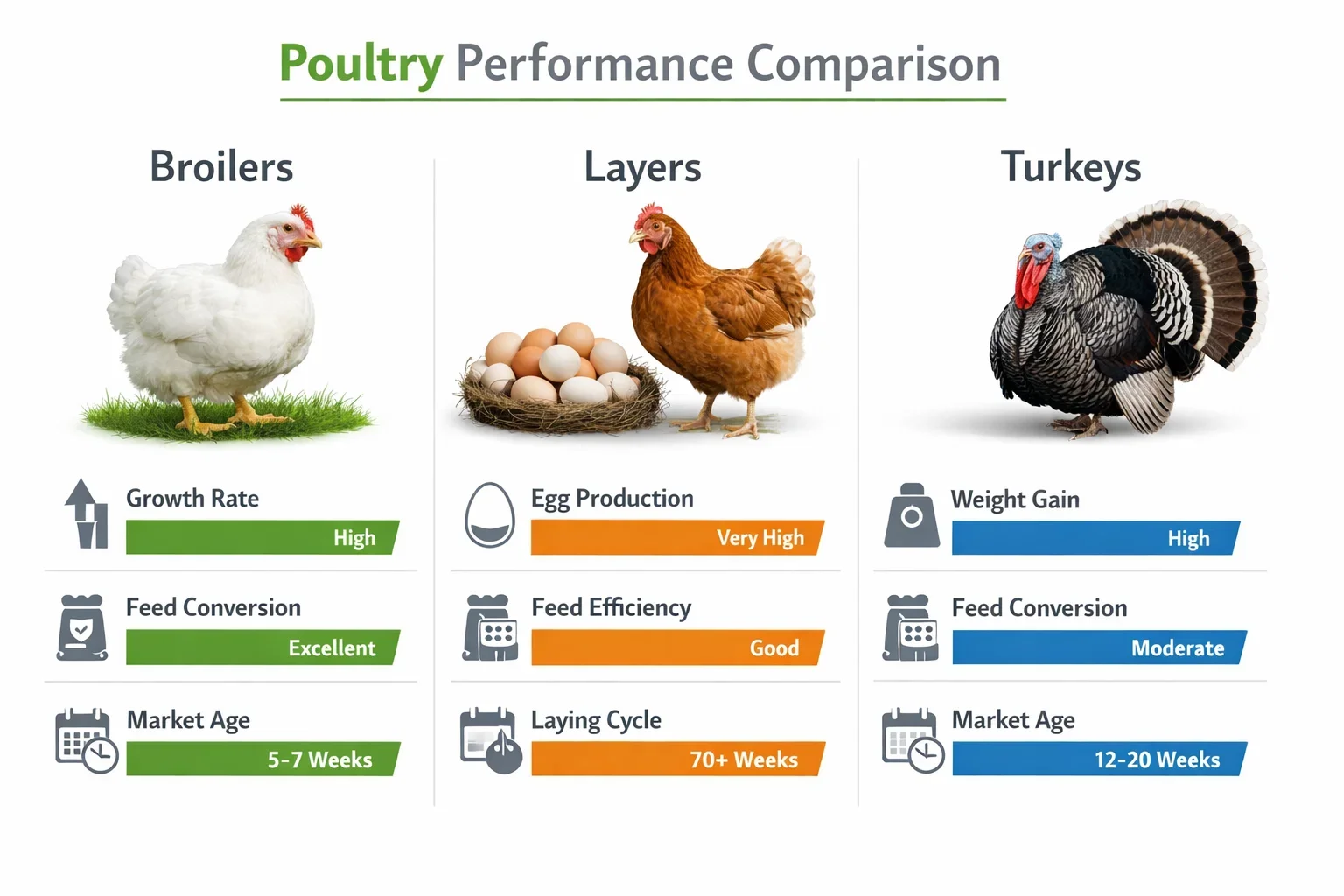
Different categories of poultry have different FCR standards. Comparing your flock’s performance against established benchmarks is an essential part of monitoring poultry performance indicators FCR effectively.
| Poultry Type | Production Stage | Target FCR Range | Excellent FCR |
| Broilers (Commercial) | 4–6 weeks | 1.6 – 1.85 | Below 1.6 |
| Broilers (Extended) | 6–8 weeks | 1.85 – 2.10 | Below 1.85 |
| Laying Hens | Peak lay (kg feed/dozen eggs) | 1.4 – 1.6 kg | Below 1.4 kg |
| Turkeys | Market weight | 2.2 – 2.6 | Below 2.2 |
| Layer Pullets | Rearing phase | 2.5 – 3.0 | Below 2.5 |
These benchmarks are starting points. Actual targets will vary based on genetics, climate, housing system, and the specific nutritional program in place at your operation.
Industry Fact: Over the past 50 years, selective breeding and improved nutrition have helped the commercial broiler industry improve FCR by more than 30%, reducing the feed required per kilogram of meat produced significantly. Modern commercial broilers can reach market weight in as few as 35–42 days as a direct result of advances in feed formulation and genetic selection.
Key Poultry Performance Indicators Alongside FCR
While FCR is the primary tool for measuring feed efficiency in poultry, it is most meaningful when evaluated alongside other poultry performance indicators. These metrics together provide a complete picture of flock health and productivity.
- Average Daily Gain (ADG): Measures the average body weight gained per bird per day, indicating growth velocity throughout the production period.
- Livability / Survival Rate: The percentage of birds that survive to the end of the cycle, which directly impacts both the FCR calculation and total revenue.
- European Production Efficiency Factor (EPEF): A composite score that incorporates FCR, daily gain, livability, and slaughter age into a single performance index.
- Uniformity: The percentage of birds within 10% of the average body weight, reflecting consistency of management and nutrition delivery across the flock.
- Hen-Day Production (for layers): The percentage of hens producing an egg on any given day, a key indicator of laying efficiency.
Tracking these indicators together helps producers make smarter decisions. For example, a low FCR paired with poor livability may still indicate an underlying health issue that needs to be addressed before overall efficiency improves.
How to Improve Feed Efficiency in Poultry
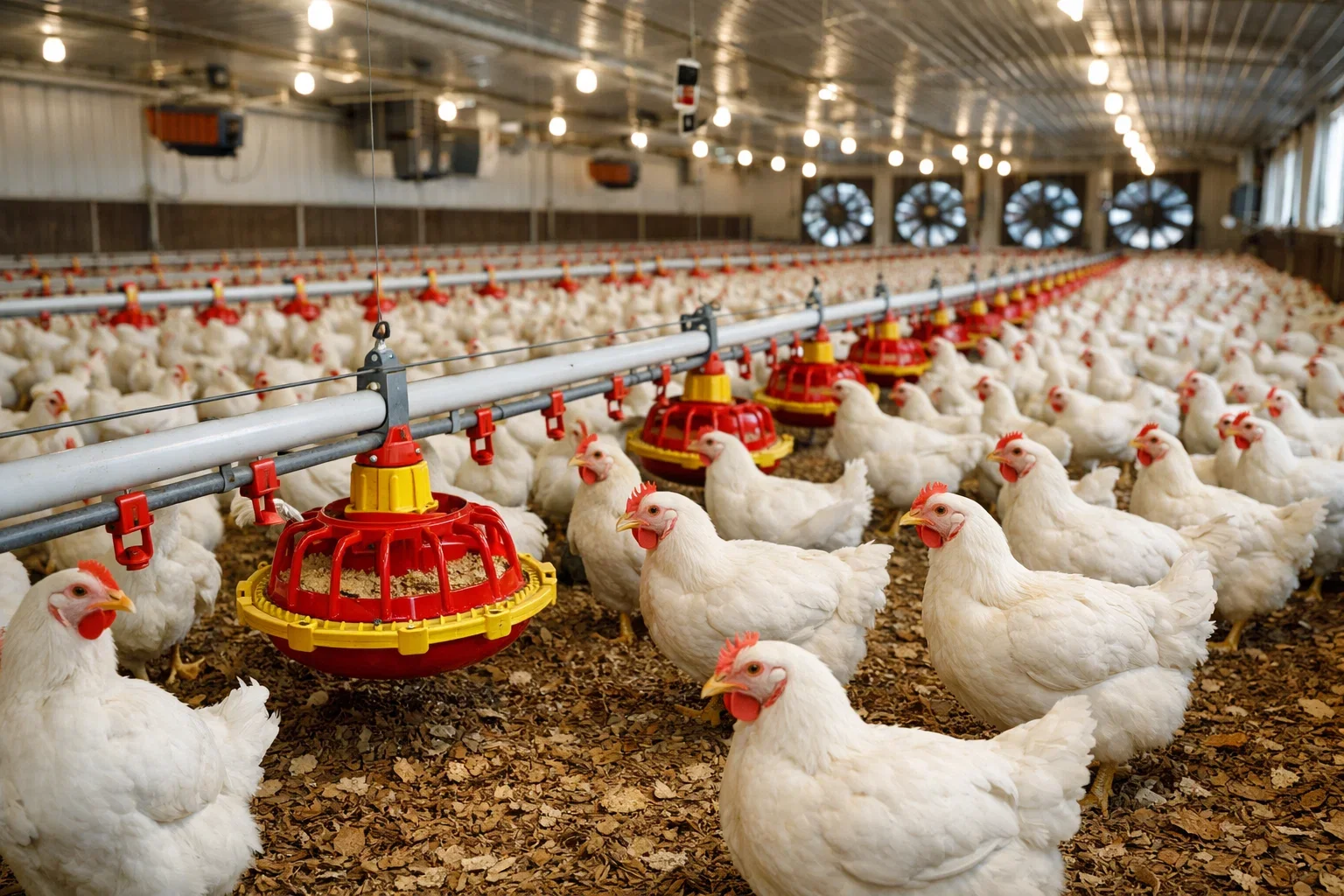
Improving feed efficiency in poultry involves a combination of nutrition management, environmental control, biosecurity, and genetics. Even small improvements in FCR translate into significant cost savings at scale when managing thousands of birds.
- Optimize feed formulation: Work with a qualified nutritionist to ensure the diet meets the specific amino acid, energy, and micronutrient requirements of your breed and production stage.
- Minimize feed wastage: Properly adjusted feeders and correct feeder space allocation can reduce physical feed waste by up to 5–8% in many operations.
- Maintain optimal house temperature: Birds in thermally neutral environments use less energy for temperature regulation and more for productive growth.
- Implement strict biosecurity: Subclinical infections and gut health issues are among the leading hidden causes of poor FCR, even in flocks that appear healthy.
- Use high-quality, consistent raw materials: Feed ingredient variability especially in energy and protein sources is a major cause of FCR fluctuations between flocks.
- Monitor water quality and intake: Water consumption directly drives feed intake; poor water quality suppresses drinking and eating simultaneously.
Common Feed Efficiency Table by Age in Broilers
The FCR in broilers changes as birds age, becoming progressively less favorable as the bird grows larger and proportionally more feed is used for maintenance rather than growth. Monitoring FCR by week helps producers identify exactly when performance begins to deviate from targets.
| Week | Cumulative FCR (Target) | Average Body Weight (g) | Average Feed Intake (g/bird) |
| Week 1 | 0.85 – 0.95 | 180 – 200 | 160 – 190 |
| Week 2 | 1.20 – 1.30 | 500 – 560 | 620 – 700 |
| Week 3 | 1.35 – 1.45 | 1,000 – 1,100 | 1,400 – 1,550 |
| Week 4 | 1.50 – 1.60 | 1,550 – 1,700 | 2,350 – 2,600 |
| Week 5 | 1.65 – 1.75 | 2,100 – 2,300 | 3,500 – 3,850 |
| Week 6 | 1.80 – 1.95 | 2,600 – 2,850 | 4,900 – 5,400 |
Key Fact: Research consistently shows that for every 0.1-point improvement in FCR across a 20,000-bird broiler house, a producer can save approximately 2,000 kg of feed per flock, a meaningful cost reduction when multiplied across multiple cycles per year.
Nutrition Quality and Its Role in Feed Efficiency
The nutritional composition of feed is perhaps the single greatest driver of FCR outside of genetics. Feed that is well-balanced in digestible amino acids, metabolizable energy, and key minerals enables birds to grow rapidly and consistently without wasting nutrients through excess excretion.
Digestibility enhancers such as phytase and xylanase enzymes have become standard tools in modern poultry nutrition programs. Phytase releases phosphorus bound in plant-based ingredients, reducing both feed cost and environmental phosphorus output simultaneously, a clear win for efficiency and sustainability.
The energy-to-protein ratio in the diet must also be carefully matched to the bird’s genetic potential and production stage. An energy-deficient diet forces the bird to catabolize protein for energy, wasting expensive amino acids and suppressing growth, while an overly energy-dense diet can reduce feed intake in hot climates, limiting total daily nutrient delivery.
Conclusion
Understanding how to calculate feed efficiency in poultry and actively working to improve it is one of the most impactful things a poultry producer can do to strengthen the profitability and sustainability of their operation. A disciplined approach to FCR monitoring, supported by strong nutrition, sound health management, and reliable performance benchmarking, gives producers the insight they need to make confident decisions every production cycle.
Choosing the right feed partner is just as important as understanding the numbers. Mid-South Feeds brings deep expertise in poultry nutrition and is dedicated to helping producers achieve consistent, high-quality results through well-formulated, field-proven feed programs designed specifically for the performance targets of modern commercial poultry operations. Producers looking to connect with trusted supply points can easily use the dealer locator to find nearby distributors and ensure consistent access to quality feed.
Whether you are fine-tuning a broiler program or optimizing your layer nutrition, the team at Mid-South Feeds understands that every point gained in efficiency matters. For those interested in expanding opportunities within the feed industry, you can also apply for dealership and become part of a network committed to performance, reliability, and long-term success in poultry production.
1. What is feed efficiency in poultry?
Feed efficiency in poultry measures how effectively birds convert feed into body weight or eggs, showing how well resources are used. Better efficiency means more output with less feed, improving overall farm profitability.
2. How do you calculate Feed Conversion Ratio (FCR)?
FCR is calculated by dividing total feed consumed by total weight gained over a production period. A lower FCR indicates better feed efficiency and reduced feed cost per unit.
3. Why is FCR important in poultry farming?
FCR directly impacts production costs because feed is the largest expense in poultry farming. Improving FCR increases profitability and overall operational efficiency.
4. What is a good FCR for broilers?
A good FCR for broilers typically ranges between 1.6 and 1.85 under standard commercial conditions. Values below 1.6 are considered excellent and indicate highly efficient production.
5. How is feed efficiency calculated in layers?
In layers, feed efficiency is measured as the amount of feed consumed per dozen eggs or per kilogram of egg mass. Lower feed consumption per unit of egg output reflects better efficiency.