 Dogs & Cats
 Cattle
 Equine
 Poultry
 Swine
Swine Goats & Sheep
 Game Bird
 Gamecock
 Deer & Wildlife
 Fish & Pond
 Rabbit
 Specialty
 Ingredients & Bulk
 Special Order
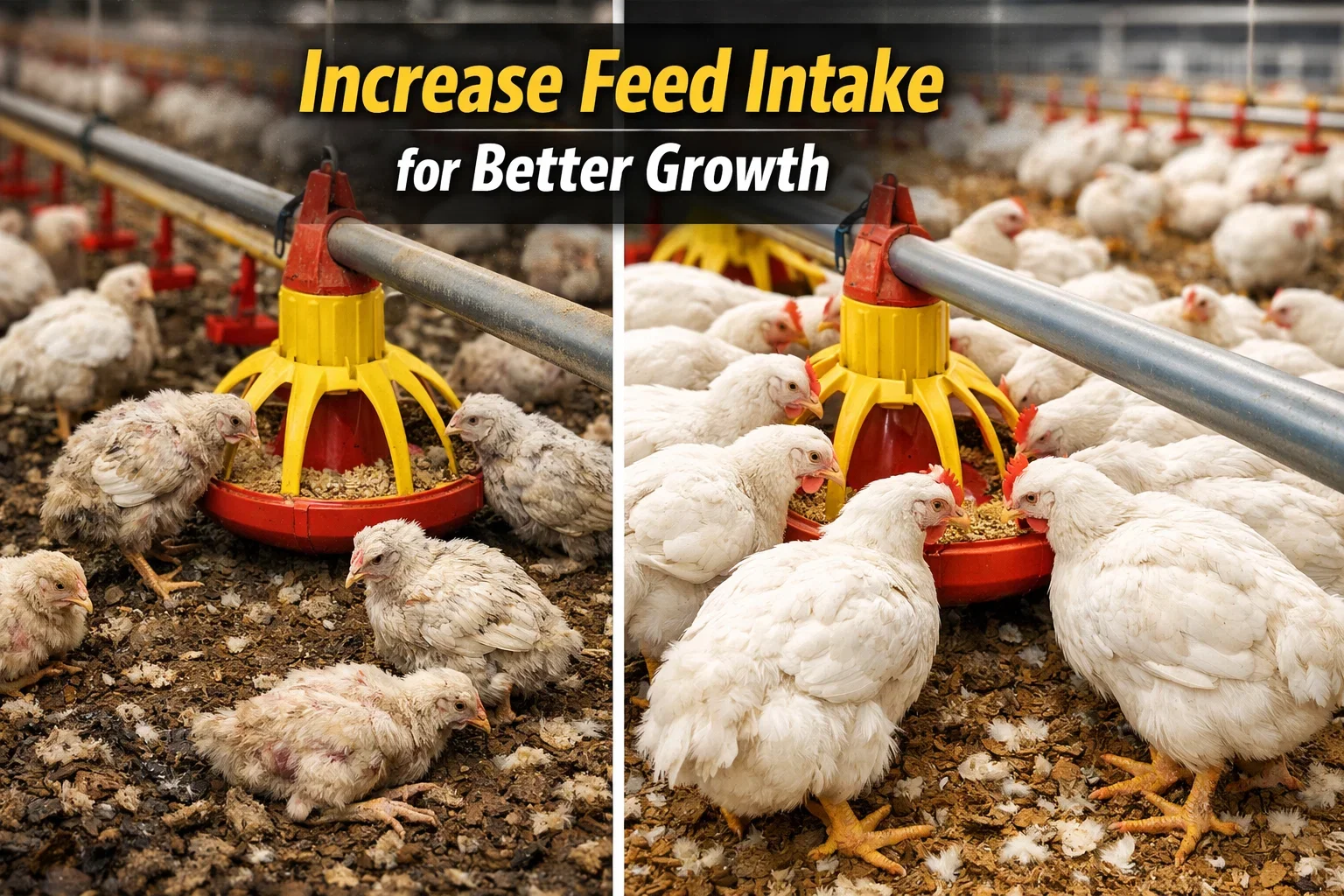
On feed your birds are slow. Weight gain has stalled. Egg numbers are off. You should know before you change the formula or call the vet that low feed intake in poultry is nearly always a management or health issue rather than a feed issue.
More than 70 percent of the total poultry production costs are composed of feeds. When consumption decreases, all decrease with it growth, eggs, and margins. To begin with, the first step to fixing it is to know what actually causes a lack of appetite in the first place.
Why Are Chickens Eating Less Feed?
Symptomatic rather than causal is low feed consumption. This has been identified in a foundational review that was published on ResearchGate named Factors That Affect Feed Intake of Meat Birds: the effect of management and health stressors on feed intake is much more consistent than the effect of diet. When one barn is feeding fine and the other is not, the feed is hardly ever the variable.
The real culprits fall into four main categories:
- Temperature and environment – heat stress is the single biggest driver of reduced intake
- Water availability and quality – warm, dirty, or restricted water directly cuts feed consumption
- Disease and gut health – subclinical infections suppress appetite before symptoms appear
- Feed form and palatability – wrong particle size, rancid fat, or mycotoxins reduce voluntary intake
Each one is identifiable and fixable if you know what to look for.
What Factors Affect Feed Intake in Poultry the Most?
1. Heat Stress – The Biggest Suppressor

Chickens are homeothermic, which means that they have a constant body temperature within their bodies. When ambient temperatures exceed their thermoneutral range of about 60 to 75 °F of most poultry they voluntarily reduce feed consumption to lessen the heat of metabolism derived as a result of digestion. It is not a behavioral quirk. It is pure physiology.
Research published in PMC on heat stress and poultry production confirms that heat stress leads to:
- Decreased feed intake across broilers, layers, ducks, and turkeys
- Reduced body weight and lower egg production
- Worse feed conversion ratios
- Economic losses estimated at over $1 billion annually in U.S. poultry agriculture alone
According to researchers Mangan et al. in the Journal of Animal Physiology and Animal Nutrition (2024): birds do not have sweat glands, so they decrease physical activity and food intake to lower the production of internal heat, and increase panting and the consumption of water to cool down with the help of evaporation.
What to do: Feed the birds in the two coolest times of the day early morning and late evening. The natural behavior of poultry is that they increase their feed during the time of lights on and before lights off. According to the Extension Poultry Specialist at North Carolina State University, Kenneth E. Anderson, this timing change is among the most direct methods of maintaining nutrient intake during heat stress.
2. Water Intake and Feed Intake in Poultry Go Together
Background support is not an option, water is an essential component of all the metabolic processes involved in digestion, nutrient absorption and temperature regulation. It has been found that broilers use approximately twice the amount of water to feed per pound as they grow up. That only tells you the degree of affiliation between the two.
In the Department of Poultry Science of Mississippi State University, Dr. Tom Tabler and his associates have reported that under warm, dirty and inadequately fed water, the amount of feed consumed decreases according to the same proportion. Hot water lines adjacent to beams on ceilings on a hot summer afternoon are one of the causes of low flock performance which are the least diagnosed and most producers never check them.
Minimum flow rate reference: Multiply bird age in weeks by 7, then add 20. For an eight-week-old broiler, that is at least 76 milliliters per minute per nipple drinker. Anything below that and birds go thirsty then they stop eating.
To keep water working in your favor:
- Flush water lines daily during hot periods to clear out warm standing water
- Position pipes away from ceilings and metal rooflines where heat collects
- Add electrolytes to drinking water for up to three days during heat stress events
- Track daily water consumption as a proxy when water intake dips, feed intake follows within 24 hours
3. Disease and Gut Health – The Hidden Performance Killer
Subclinical infection and intestinal dysbiosis inhibit appetite long before any signs manifest themselves. Inflammatory response by the immune system removes the energy used in growth and production and the process of this dimension is naturally regulated by birds by decreasing the amount of food consumed. It is a signal within you, rather than in the management that you can see standing outside the barn.
This is the reason why an abrupt unaccounted loss of feed consumption needs to alert to a flock health examination prior to any adjustment being made along the feed-side. By the time overt clinical manifestations become visible diarrhea, lack of energy, difficulty breathing, considerable losses in the laboratory, and other important signs have been already experienced. The early warning mechanism is the intake drop in case you are paying attention to it.
4. Feed Form and Palatability

Pelleted feed is usually effective in feed conversion since it is faster and less laborious to be consumed by chickens. Mash and crumbles are good with younger birds when the particle size is the same age and beak development is the same. Rancid fat, mycotoxins, and excess moisture contamination causes the voluntary intake to be rapidly decreased, particularly in young flocks that have not yet formed good feeding habits.
Signs that feed form or quality may be the problem:
- Feed refusal that starts suddenly after a new batch delivery
- Birds picking through feed rather than consuming it steadily
- Visible clumping, off smell, or discoloration in the feed bin
- Intake drop that affects the entire flock at the same time
How to Stimulate Appetite in Poultry Using Feed Additives
After the environmental fundamentals have been taken care of, the second lever is gut health. A bird that has a weakened gut has a lower food intake, fewer nutrients in each gram intake, and is an ineffective nutrient converter, all three issues that reinforce one another. This is dealt with by probiotics, prebiotics and digestive enzymes at the very cause.
Probiotics
A 2025 systematic review published in Microorganisms (MDPI) found that probiotic supplementation delivers three specific improvements in poultry:
- Better nutrient digestibility and absorption at the gut level
- Reduced incidence of gastrointestinal disorders that suppress appetite
- Increased feed intake through direct appetite stimulation
These mechanisms are improved gut barrier integrity, improved digestive enzyme production and more balanced gut microbiome. Lactobacillus, Bifidobacterium, Saccharomyces, Bacillus subtilis, and Bacillus licheniformis are the most commonly used strains in commercial production.
An industry survey conducted by WATT Global Media (2024) identified that eighty-two percent of poultry feed specialists considered probiotics to be the best feed additive to antibiotics. A report administered by AgValue Consulting of one instance where probiotics and enzymes were supplemented to the diet of an organic flock showed an increase in feed conversion rates by 12 percent, which would not be marginal at production scale.
Digestive Enzymes
Exogenous enzymes are used to aid the digestion of nutrients that were problematic to the digestive system of the birds especially when they are fed on a diet rich in fibre or non-traditional foods. The literature on poultry nutrition at the ScienceDirect has shown that enzyme preparations increase the bioavailability of nutrients, particularly in the presence of anti-nutritional factors in the feed.
The synergistic effect on amino acid digestibility with the use of enzymes and probiotics is not possible with each of them individually. In case gut health is a putative etiological factor of low intake, a combination of the two is a supported place of initiation.
Does Nutrient Density Matter When Feed Intake Is Low?
Yes and it is one of the more practical things you possess. When the birds feed less because of heat or stress, they feed on less total nutrients. The proper action is to concentrate nutrients in each gram that is eaten, and not to stuff a bird that has already started to resist.
Kenneth Anderson of NC State University explicitly recommends nutrient density adjustment as a direct response to heat-driven intake reductions. Practical ways to increase nutrient density include:
- Replacing some dietary carbohydrates with fat fat is calorie-dense and produces less metabolic heat during digestion
- Increasing amino acid concentrations to match reduced intake volumes
- Using higher-bioavailability mineral and vitamin premixes so less feed delivers the same micronutrient load
- Working with your feed supplier to reformulate for seasonal heat stress periods rather than using a single year-round formula
Conclusion
The most significant factor by which the body weight gain and feed efficiency in poultry are affected is feed intake. Church and Pond (1999) reported in an article that, as they suggested, management and health considerations almost always tend to lower the feed intake compared to dietary considerations. When the bird gets full, it understands how full it is, there is something in its environment or its health that it is informing it.
Locate that signal in the waterer, the thermometer or the gut and eliminate it. There is hardly ever an answer out of that. Our nutritionally balanced poultry feeds are designed to withstand the real production conditions and our expert staff is also available to assist you in determining what your flock is telling you.
Our nutritionally balanced poultry feeds are designed to perform under real production conditions, helping birds maintain consistent intake and efficiency. Our expert team is also available to support you in understanding what your flock is communicating through its behavior and performance. To ensure easy access to our products, you can use our dealer locator to find a trusted supplier near you. If you are interested in growing with a reliable feed partner, you can also apply for dealership and become part of a network committed to delivering consistent quality and results in modern poultry production.
Frequently Asked Questions
1. Why do chickens eat less during summer?
Chickens eat less in hot weather to reduce body heat production naturally. Ventilation, cool water, and proper feeding times help improve intake.
2. How does water affect feed intake in poultry?
Chickens drink about twice as much water as feed, so poor water quality reduces intake quickly. Warm or low-flow water directly leads to lower feed consumption.
3. What feed additives actually stimulate poultry appetite?
Probiotics improve gut health and increase feed intake effectively. Digestive enzymes enhance absorption, and both work best when used together.
4. How quickly can disease suppress feed intake?
Feed intake can drop within 24–48 hours after disease onset. Sudden decline should prompt a health check before changing feed.
5. What is the feed cost share of total poultry production cost?
Feed makes up over 70% of total poultry production costs. Small improvements in feed efficiency can significantly boost profitability.